
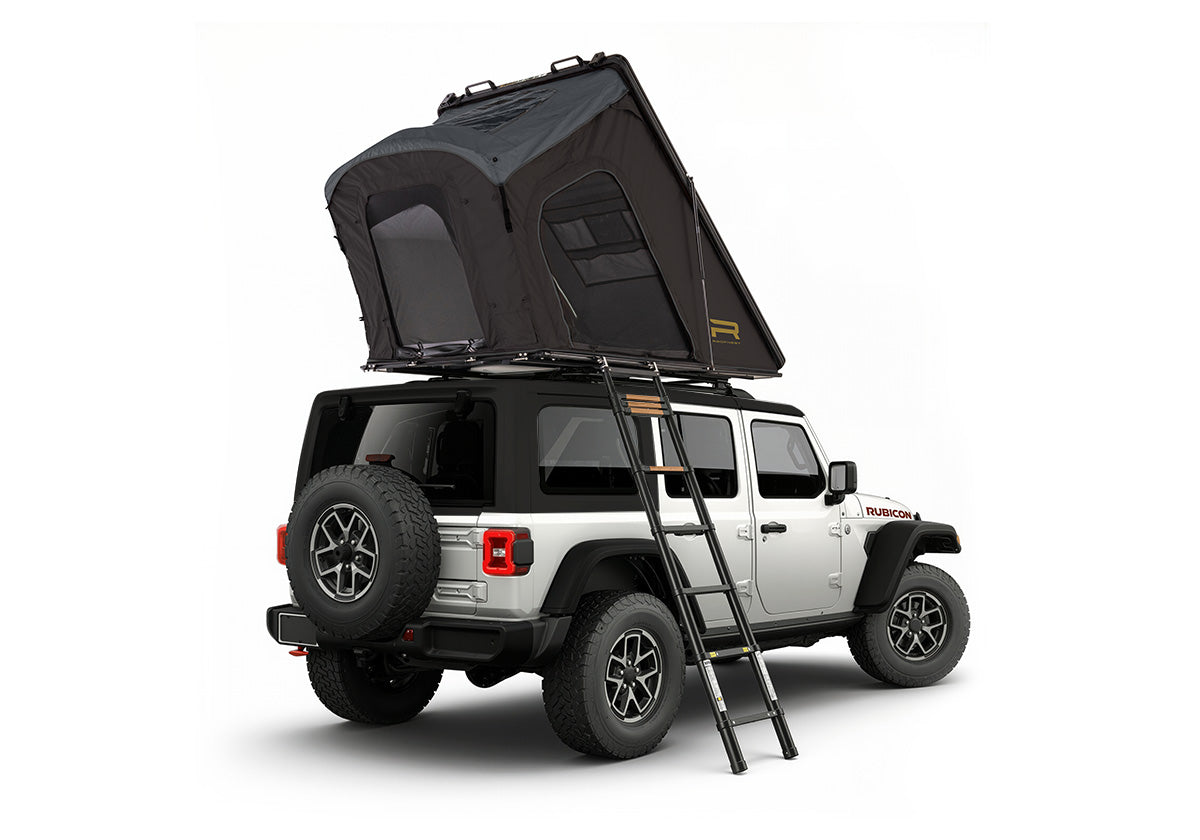
✅ Quick Answer
Falcon = low-profile aerodynamic pick (best for daily-driver Wranglers, keep MPG high). Condor = maximum interior space + queen mattress (best for extended overland trips).
You’ve decided on Roofnest as your rooftop tent brand. Now the real question: Roofnest Falcon or Roofnest Condor? Both are Roofnest hardshells. Both fit Jeep Wranglers. Both are trusted premium tents. But they solve the space-vs-profile trade-off differently, and picking the wrong one for your use case is a $2,000+ mistake.
This post covers the internal Roofnest decision. If you’re still comparing brands, see our Roofnest vs iKamper Skycamp comparison first. This is the “which Roofnest” follow-up for buyers already committed to the brand.
Short version: the Falcon is a wedge-style hardshell for 2 people with the lowest possible profile. The Condor is a clamshell-style hardshell that fits 2-3+ with more headroom but a taller closed silhouette.
TL;DR — The 60-Second Verdict
Buy Roofnest Falcon 3 Evo if:
- You’re 1-2 people (solo or couple)
- You want the lowest closed profile Roofnest makes
- You value fast setup (~30 seconds gas-strut assist)
- You need garage clearance or care about highway aerodynamics
- You want the lightest Roofnest option
Buy Roofnest Condor 2 if:
- You’re 2-3 people (family, larger couples, kids)
- You want the largest sleeping footprint Roofnest offers
- You value standing headroom for changing clothes
- You’re okay with a taller closed profile
- You want the maximum interior space in the Roofnest lineup
One-line answer for a Wrangler owner: Falcon for solo/couples. Condor for families. Both are legitimately great; pick based on how many people sleep in it, not on which is “better.”
Ready to buy? Check current pricing at Roofnest:
The Two Tents in One Paragraph Each
Roofnest Falcon 3 Evo is a pop-up wedge hardshell. Closed profile is ~10″ tall — one of the lowest in the hardshell category. Opens via gas struts in ~30 seconds to reveal a triangular sleeping space with the peak at the front and entrance at the rear. Sleeps 2 adults on a 50″ W x 84″ L mattress. Weight ~135 lbs. Base price ~$3,195. The Falcon 3 Evo is Roofnest’s current-generation wedge, refined with better hinges and materials than earlier Falcon versions.
Roofnest Condor 2 is a clamshell-style hardshell. Closed profile is ~13″ tall — taller than the Falcon but still compact for a clamshell. Opens like a suitcase — unlatch, and the shell hinges open to reveal a rectangular sleeping space. Sleeps 2-3 people (larger footprint than Falcon). Weight ~150 lbs. Base price ~$3,395. There’s also a Condor 2 Air model with additional storage-air-lift design.
Direct Feature Comparison
| Feature | Roofnest Falcon 3 Evo | Roofnest Condor 2 | Buy |
|---|---|---|---|
| Style | Pop-up wedge | Clamshell | Falcon Condor |
| Base price | ~$3,195 | ~$3,395 | Falcon Condor |
| Sleeping capacity | 2 adults | 2-3 people | Falcon Condor |
| Sleeping area (W×L) | 50″ × 84″ | ~60-70″ × 84″ | Falcon Condor |
| Closed height | ~10″ | ~13″ | Falcon Condor |
| Weight | ~135 lbs | ~150 lbs | Falcon Condor |
| Setup time | ~30 sec | ~45-60 sec | Falcon Condor |
| Interior headroom | Limited to rear peak | Standing headroom at center | Falcon Condor |
| Shell material | Aluminum-composite | Aluminum-composite | Falcon Condor |
| Warranty | 5-year limited | 5-year limited | Falcon Condor |
Where the Falcon 3 Evo Wins
Lowest Closed Profile
At ~10 inches tall closed, the Falcon has the lowest profile Roofnest makes. Matters for:
- Garage clearance: Many suburban garages have 7-8″ door openings. Falcon fits where a Condor won’t.
- Highway aerodynamics: Less frontal area = better fuel economy. Real-world: 1-2 MPG better with Falcon vs Condor.
- Aesthetics: Falcon complements a Jeep’s silhouette. Condor is boxier and taller.
Faster Setup
Gas-strut assisted pop-up = ~30 seconds from closed to sleeping. Condor’s clamshell design requires unlatching and physically opening the shell — ~45-60 seconds. Not a huge deal on a two-night trip, but adds up when you’re moving camp daily.
Lighter Weight
135 lbs vs 150 lbs = 15 lbs less on the roof. Add a roof rack (40-60 lbs), and Falcon build is 195 lbs vs Condor 210 lbs on the roof of a stock JK/JL Wrangler.
For stock suspensions, staying under 200 lbs on the roof preserves handling and reduces the argument for a lift kit.
Better for Winter/Cold-Weather Use
Smaller interior volume = easier to heat with a portable heater. Falcon’s wedge shape warms up faster than the Condor’s larger clamshell interior.
Lower Entry Price
$3,195 vs $3,395 = $200 delta. Same brand, same warranty, same quality — just less space if you don’t need it.
Where the Condor 2 Wins
Meaningfully More Space
Condor’s clamshell design gives you 20-40% more sleeping footprint than the Falcon. For 2 adults + 1 kid, or 3 close friends, Condor fits comfortably. The Falcon simply doesn’t have the footprint.
Even for couples, some prefer Condor’s extra space for the additional roll-around room.
Standing Headroom at Center
Falcon’s wedge shape means you can only sit upright at the rear (peak) of the tent. Condor’s clamshell design gives you standing-height clearance at the center — enough to change clothes, sit cross-legged anywhere in the tent, and generally move around comfortably.
For anyone over 6′ tall or spending 3+ nights per trip, headroom is a comfort multiplier.
Better for Extended Trips
For multi-day overland trips (5+ nights), Condor’s comfort advantage compounds. Sleeping better for a week matters more than saving 15 lbs of roof weight.
The Condor 2 Air Variant
Condor 2 Air adds an air-assist opening mechanism — further reduces setup effort while retaining the Condor’s space advantage. If you’re considering Condor and want the smoothest deploy, the Air upgrade is worth the price difference.
Family / Group Camping Value
One Condor is a real solution for a family of 3, whereas two Falcons (or a Falcon + ground tent) is worse in most dimensions. The Condor consolidates gear and simplifies camp.
Where They’re Roughly Tied
- Build quality: Both are Roofnest hardshells with identical construction standards.
- Stock mattress quality: Both ship with 3″ foam that most owners eventually upgrade — see our rooftop tent mattress guide.
- Weather resistance: Both are 4-season capable with matching insulation kits.
- Roof rack compatibility: Both fit standard 60″+ crossbar spreads. See our roof rack guide for compatible platforms.
- Warranty: Both 5-year limited from Roofnest.
- Ecosystem accessories: Both work with Roofnest awnings, ladder options, and accessory line.
The Pricing Fine Print
Roofnest Falcon lineup:
- Falcon 3 Evo: ~$3,195
- Falcon 3 Evo XL Air (larger + air-assist): ~$3,795
Roofnest Condor lineup:
- Condor 2: ~$3,395
- Condor 2 Air (air-assist opening): ~$3,795
The real math: Falcon 3 Evo vs Condor 2 = ~$3,195 vs ~$3,395 = $200 delta. For that $200, Condor gives you meaningfully more sleeping footprint and headroom. Whether that’s worth it depends entirely on your group size.
The Air upgrade: Both Falcon and Condor offer “Air” variants (~$600 more each) with air-assist opening. Nice-to-have; not need-to-have.
Which Should You Buy? (Real Recommendations by User Type)
Solo overlander → Roofnest Falcon 3 Evo
Falcon fits solo perfectly. Lower profile, faster setup, and lighter weight are all wins with no downside since you don’t need the extra Condor space.
Couple, occasional camping → Roofnest Falcon 3 Evo
Falcon sleeps 2 comfortably. Save the $200 for a mattress upgrade or awning.
Couple, frequent camping (15+ nights/year) → Roofnest Condor 2
At frequent use, Condor’s extra space and headroom pay back in daily-use comfort. The $200 premium becomes meaningful when spread over 15+ nights.
Family with kids → Roofnest Condor 2
Non-negotiable. Falcon simply doesn’t have the footprint for 2 adults + a kid. Condor is the family answer within the Roofnest lineup.
Group camping with friends → Roofnest Condor 2
Same logic. Three adults share the Condor. Falcon caps at two.
Winter/cold-weather overlander → Roofnest Falcon 3 Evo
Smaller interior heats faster with a portable heater. Falcon’s wedge geometry retains heat better than Condor’s larger volume.
Weight-conscious build (stock suspension) → Roofnest Falcon 3 Evo
15 lbs matters when preserving factory JK/JL handling.
Aesthetic priority (garage, daily driver) → Roofnest Falcon 3 Evo
Falcon’s low-profile wedge is aesthetically cleaner on a Jeep than Condor’s boxy silhouette.
Want the smoothest deploy → Roofnest Condor 2 Air
Air-assist opening on the Condor 2 Air combines the space of Condor with reduced setup effort.
FAQ
Can I fit either tent on a 2-door Jeep Wrangler?
Yes for both. On 2-door Wranglers, the Falcon looks proportionally better because of the shorter wheelbase and lower profile. Condor works but hangs off the vehicle more visually.
Which is easier to close in bad weather?
Falcon — gas-strut assisted, closes in ~30 seconds. Condor takes ~60-90 seconds to fold and latch. In sudden downpours, Falcon is friendlier.
Which handles wind better?
Falcon — the lower profile catches less wind at highway speeds and while parked. Condor’s taller closed profile means more sway in high winds.
Can I upgrade the mattress on either?
Yes. See our rooftop tent mattress guide for aftermarket options that fit either tent’s geometry.
Do both fit standard roof racks?
Yes. Both mount to standard 60″+ crossbar spreads. Compatible with Front Runner Slimline II, Rhino-Rack Pioneer, Yakima LoadWarrior. See our roof rack guide for platform picks.
Is the Condor 2 Air worth $400 more than the standard Condor 2?
For frequent overlanders (15+ nights/year), yes — the air-assist reduces daily setup effort. For occasional users, no — the standard Condor 2 is enough.
Which one has better resale value?
Both hold value well — 60-70% after 3 years on the used market. Slight edge to Falcon due to broader appeal (fits both solo and couples).
Can I switch tents later if I choose wrong?
Yes, but you’ll lose 25-30% in transaction friction (selling, shipping, buying). Better to buy the right one first — and default to the one that fits your actual group size, not your aspirational family.
Final Recommendation
If you’re solo or a couple: Get the Roofnest Falcon 3 Evo. Lower profile, faster setup, lighter weight. All advantages, no downsides for your group size.
If you have kids or camp with 3+ people: Get the Roofnest Condor 2. Extra footprint and standing headroom are non-negotiable at that group size. Consider the Condor 2 Air for the smoothest daily setup.
If you’re on the fence: Default to the Falcon. You can always sleep bigger in a smaller tent, but you can’t sleep more people in a tent that doesn’t have the footprint.
Both are legitimate Roofnest hardshells with 5-year warranties. The question is fit-for-group, not fit-for-brand.
Related Reading
- Best Rooftop Tents for Jeep Wrangler (2026) — The full 17-tent comparison, if you want to see options beyond Roofnest
- Roofnest Falcon vs iKamper Skycamp — If you’re still deciding between brands
- Best Rooftop Tent Mattress Upgrades — Aftermarket mattresses for either Roofnest
- Best Roof Rack for Jeep JK — Where your Roofnest mounts