
✅ Quick Answer
Skip the reading and check current pricing:
You don’t think about recovery gear until you need it. And the first time you need it — alone, with a sinking sidewall in a sand wash forty miles from cell signal — is the worst possible moment to discover your kit is missing the one piece that would have gotten you out.
This guide is for Jeep Wrangler owners who want to skip the trial-and-error tax. It covers the six categories of gear that actually matter — recovery boards, kinetic ropes, snatch straps, soft shackles, shovels, and winches — with specific picks per category, what to buy first, and a few honest opinions about what’s worth the premium and what isn’t.
A Wrangler is one of the most capable factory off-road platforms ever built. That capability has a downside: it’ll get you a lot further from the road than most vehicles will, which means when you do get stuck, you’re going to be far from help. Recovery gear is what closes that gap.
This is a 4,000-word read. If you only have two minutes, skip to the TL;DR table for the top pick in each category, then come back when you have time.
TL;DR — Best Pick Per Category
| Category | Top Pick | Why |
|---|---|---|
| Recovery Boards | MAXTRAX Xtreme (Signature Orange) | Gold-standard recovery board. Engineered teeth, lifetime warranty. |
| Premium Kinetic Rope | Bubba Rope Renegade | Most-recommended kinetic rope in the overland community. |
| Value Kinetic Rope | ARB Kinetic Recovery Rope | ARB’s own rope. Cheaper, still rated for full Wrangler weight. |
| Snatch Strap | ARB Recovery Strap | Industry-standard 30-foot 17,500-lb strap. |
| Soft Shackles | Rhino USA Soft Shackles | Same WLL as steel, fraction of the weight, no recoil hazard. |
| Overland Shovel | DMOS Stealth Shovel | Folds compact, all-aluminum, fits under Wrangler seat. |
| Winch (Sweet Spot) | Warn VR EVO 10-S | Best price-to-performance synthetic-line winch for Wranglers. |
| Winch (Premium) | Warn ZEON 10-S Platinum | Top-of-line Warn — wireless remote, advanced motor. |
| Winch (Budget Classic) | Warn M8000 | Lighter, older, proven workhorse. Best fit for stock-weight JKs. |
| Pre-Built Kit | ARB Off-Road Recovery Kit | One-purchase solution. Strap, shackles, gloves, bag. |
Why Recovery Gear Matters More for a Wrangler
Three reasons Wranglers get stuck more than most vehicles, even when they’re driven well:
1. Confidence outpaces capability. The Wrangler’s approach angle, ground clearance, and locking diffs make easy trails feel boring. Drivers push into harder terrain than they’d attempt in any other vehicle they own, which means they end up stuck on terrain a stock 4Runner driver would never have entered.
2. Solid axles and short wheelbase eat sand. The short wheelbase that makes Wranglers great in rocks makes them worse in soft sand — the front and rear axles dig in at the same point. Once a Wrangler is high-centered in sand, you’re not driving out without boards or a winch.
3. Open diffs from the factory. Unless you’re in a Rubicon or you’ve added lockers, your Wrangler is going to spin one front wheel and one rear wheel and stop moving. You need traction-restoring gear (boards) more often than locked rigs do.
The good news: a complete recovery kit for a Wrangler is well under $1,500. The bad news: most owners buy it piecemeal after they’ve already needed each piece, which means each part shows up too late to help the first time.
This guide is structured so you can build it in the right order — by need, not by hype.
The 6-Layer Recovery System (Buy in This Order)
If money is no object, buy everything below at once. If you’re building over time, buy in this order — each layer prevents 80% of the situations the next layer is designed for:
- Recovery boards — solves the most common stuck (sand, mud, snow) without needing another vehicle. ~$300
- Snatch strap + soft shackles — gets you out when there’s another vehicle nearby. ~$200
- Folding shovel — extends what recovery boards can do (dig out tires, level the path). ~$160
- Kinetic rope — upgrade from snatch strap for heavier stucks and steeper pulls. ~$300
- Recovery kit bag (gloves, damper, hardware) — the stuff that turns a snag into a smooth recovery. ~$150
- Winch — solo recovery and tree-anchored pulls when no other vehicle exists. ~$700–$2,000
That’s a ~$2,000 build from nothing to fully equipped. You can do it for less by going with mid-tier brands across the board (this guide includes value picks alongside premium picks for every category).
Section 1 — Recovery Boards
If you buy one piece of recovery gear, buy recovery boards. They solve more real-world stuck situations than any other piece of gear, they require no other vehicle, and they work in conditions where ropes and winches don’t (open sand, no anchor points).
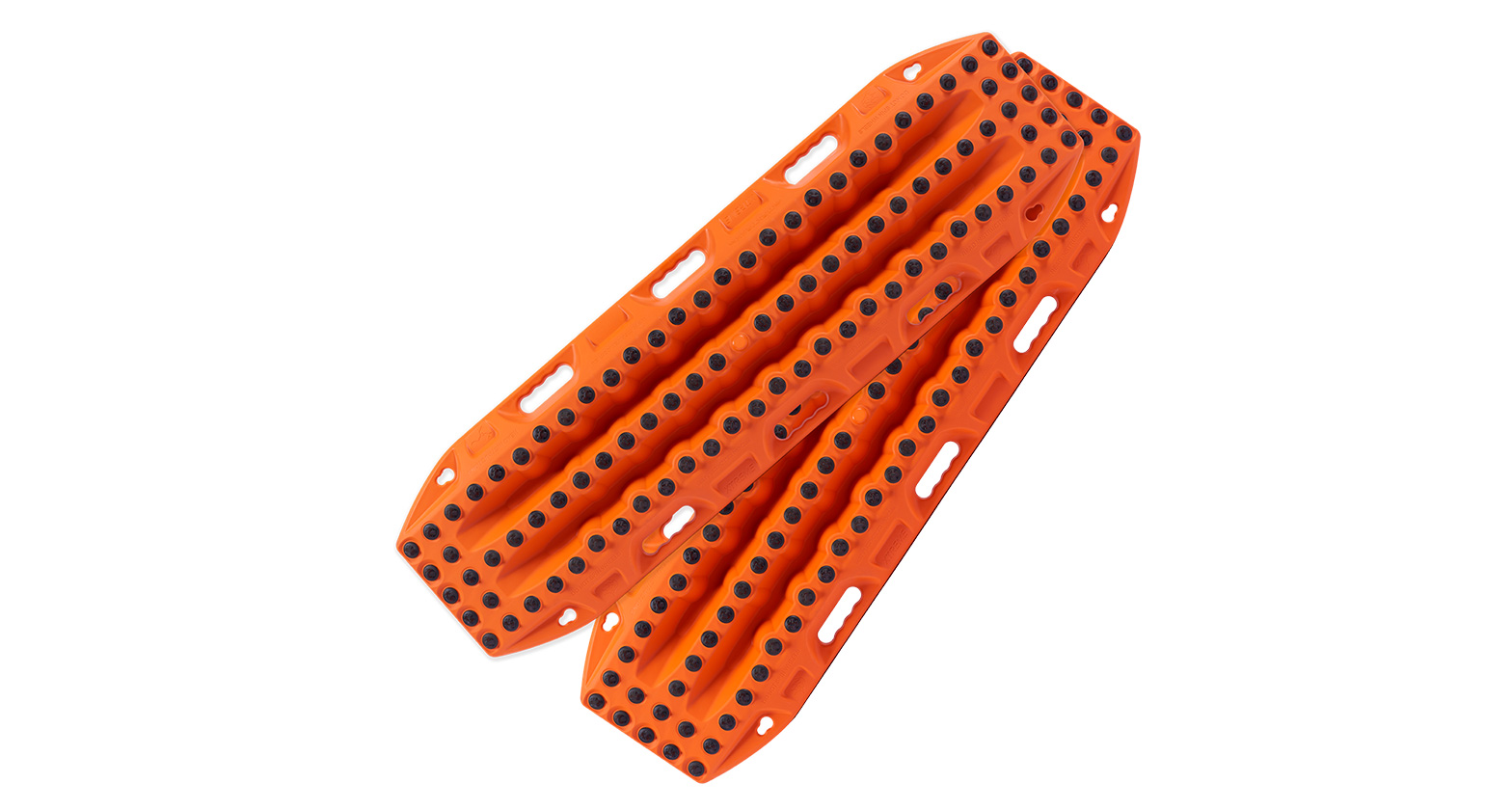
MAXTRAX Xtreme Signature — The Gold Standard
Available via Rhino Rack. ~$450 per pair.
MAXTRAX invented modern recovery boards. The Xtreme is their flagship — UV-stable nylon, engineered cleats that bite into the tire tread, and a lifetime warranty against breakage when used as recovery boards (not as bridging ladders, which is the disclaimer that voids most knockoff brands).
What sets them apart from $80 Amazon boards:
- Cleat depth and angle — the teeth are tall enough to push into a spinning tire without tearing the lug, and angled to release the tire once forward momentum is restored. Cheap boards either don’t bite or get launched by spinning tires.
- Failure mode — MAXTRAX flex and rebound under load. Cheap PP boards crack in half, often launching jagged shards.
- Mounting hardware — universal mount kit fits roof racks, tire racks, and rear bumpers.
If you’ve ever watched a recovery board fail dramatically on YouTube, it was almost always a knockoff brand. Pay the premium once.
ARB TRED Pro — The Alternative
Available from ARB. ~$300 per pair.
ARB’s TRED Pro is the most credible MAXTRAX alternative. Different cleat design (replaceable steel teeth on the Pro version), comparable rigidity, and a strong warranty. The argument for TRED: replaceable teeth mean a damaged board isn’t a thrown-out board. The argument against: heavier and more expensive than the standard TRED HD.
For most Wrangler owners, MAXTRAX is the safer recommendation because the design has been in real-world use longer and the failure modes are better understood. TRED Pro is a strong second choice — pick whichever is in stock when you’re buying.
What to Skip
Anything under $150 per pair. The construction quality drops dramatically below that price point, and recovery boards are a piece of gear that fail catastrophically when they fail.
Section 2 — Kinetic Ropes
A kinetic rope is the upgrade path from a traditional snatch strap. It stretches further under load (around 30% versus 15-20% for a polyester strap), which means it stores more energy and delivers a smoother, less violent pull. The downside is they’re expensive, and the cheap ones aren’t safe.
Bubba Rope Renegade — The Industry Favorite
Renegade (3/4″ x 20′): 19,000 lbs MBS. ~$175. The right Bubba pick for a Wrangler.
Big Bubba (1-1/4″ x 30′): 52,300 lbs MBS. ~$300. Sized for full-size trucks — skip this one for a JK or JL unless you’re recovering tow rigs.
Bubba is the most-recommended kinetic rope brand among American off-roaders. Made in Florida from double-braided nylon, dipped in their proprietary urethane coating that protects against UV and abrasion, and rated higher than comparable competition. Their lifetime warranty on workmanship is industry-leading.
For a Wrangler, the Bubba Renegade (3/4″ x 20′) is the right pick. The Big Bubba is sized for full-size trucks — overkill for a JK or JL.
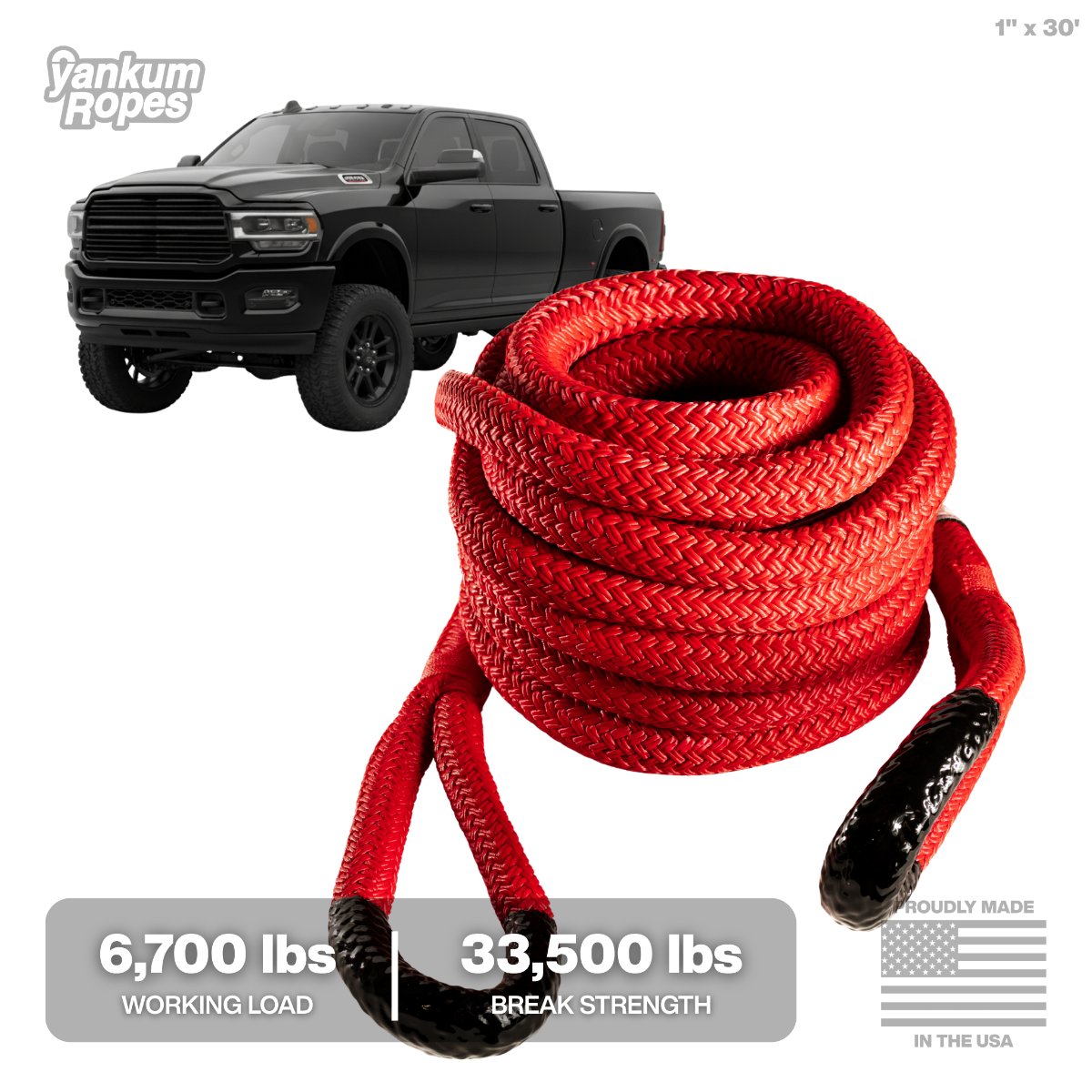
Yankum Ropes Rattler — American Premium
Rattler 1″ x 20′: 33,500 lbs MBS. ~$185.
Yankum is the newer challenger to Bubba in the premium kinetic-rope space. American-made in Florida, similar double-braided nylon construction, and their HMPE soft shackles are some of the best-reviewed on the market. Pick Yankum if you want a slightly newer brand with strong reviews and a focus on the overland market specifically.
Either Bubba or Yankum will outlast 90% of the Wranglers they’re used on. There’s no wrong pick here — it’s a brand-preference call.
ARB Kinetic Recovery Rope — Value Pick
Available from ARB. ~$170.
ARB’s own kinetic rope, in their classic blue. Rated for 17,500 lbs WLL. Cheaper than Bubba or Yankum and from a brand with deep recovery-gear pedigree. If you can’t wait for a Bubba/Yankum order and need a kinetic rope immediately, the ARB rope is the right buy — same engineering principles, just a different brand on the same Florida-style nylon.
Section 3 — Snatch Straps
A snatch strap is what you grab when another vehicle is pulling you out, you don’t have a kinetic rope, and the recovery is short and straightforward. Polyester construction with 15-20% stretch. Less expensive than kinetic ropes and forgiving for first-time users.
Every recovery kit should have one snatch strap, even if you also own a kinetic rope. They’re for different jobs.
ARB Snatch Strap (30′ x 17,500-lb) — The Standard
Available from ARB. ~$80–$110.
The ARB orange snatch strap is the industry-default recommendation. 30 feet long, 17,500-lb rating (well above any Wrangler’s loaded weight), reinforced eyes, and the classic ARB orange that’s easy to spot in tall grass when you drop it.
Sized appropriately for a Wrangler — you don’t need the 25,000-lb truck-sized strap.
Rhino USA Recovery Strap — Value Alternative
Available from Rhino USA. ~$40–$60.
Rhino USA’s recovery straps are a strong budget alternative if you’re building a kit on a tight budget. 30,000-lb rated (different testing methodology, marketed higher), polyester webbing, reinforced loops. Made in the USA. Pick this one if you’re prioritizing budget over brand recognition.
For most Wrangler owners, having both a snatch strap and a kinetic rope is the right move — they’re for different recovery scenarios.
Section 4 — Soft Shackles
Soft shackles are HMPE rope shackles that have completely replaced steel D-rings for off-road recovery in the last decade. They weigh a fraction of a steel shackle, can’t damage paint or skull if they let go, and they’re rated at or above the working load of equivalent steel.
Why Soft Shackles Replaced Steel
A 1/2″ Crosby steel shackle weighs 0.7 lbs and will turn into a 0.7-lb projectile if any part of the recovery rig fails under load. A 7/16″ soft shackle weighs 0.15 lbs and will rip rather than launch. The math is unanimous.
Modern overland recovery has largely standardized on soft shackles for all attachment points except the winch hook (where you still need either a Factor 55 ProLink or a soft shackle thimble).
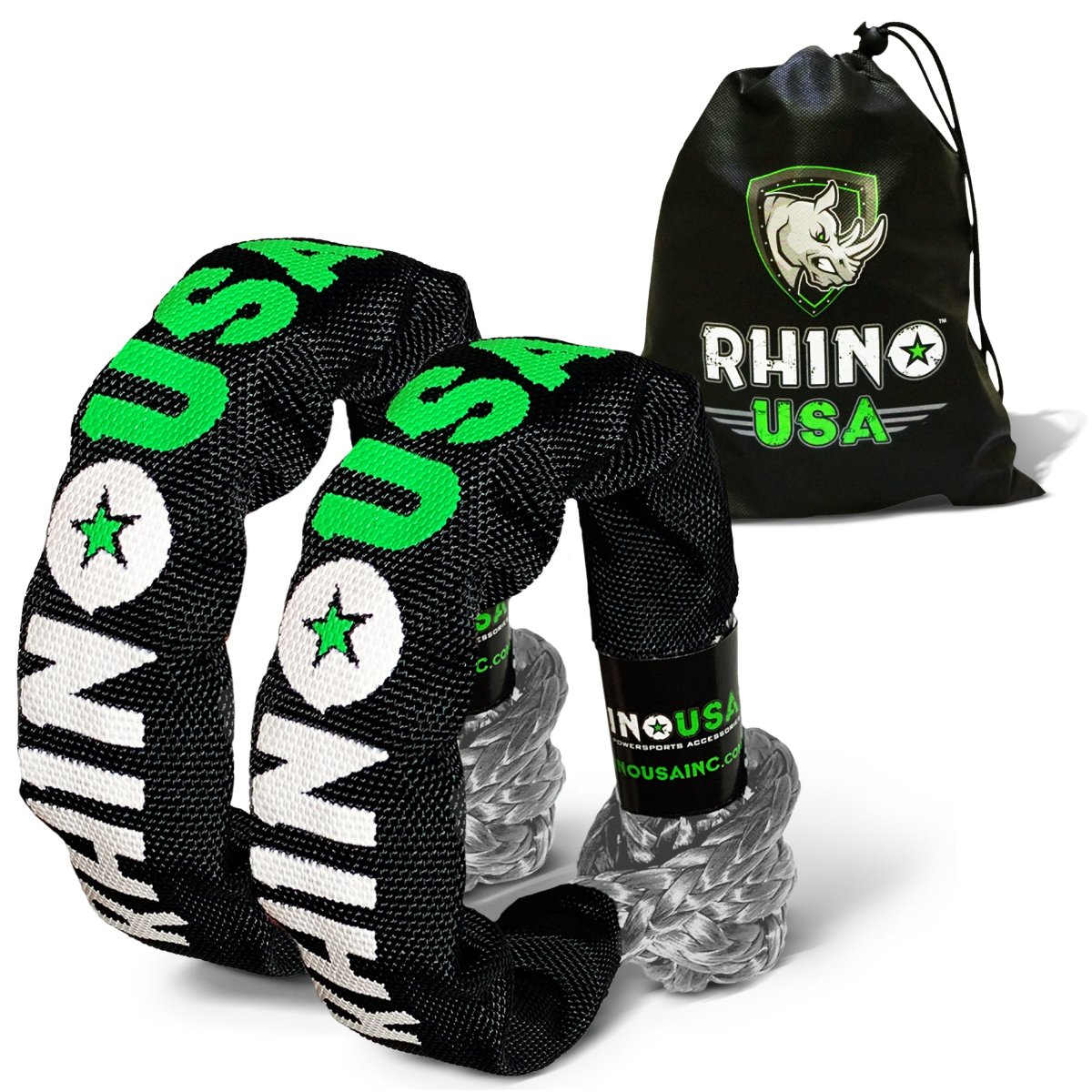
Rhino USA Soft Shackles — Best Value
Available from Rhino USA. ~$30 for a pair.
7/16″ diameter, 35,000-lb breaking strength. Two-pack means you’ve got one for each attachment point on the recovery. Rhino USA’s soft shackles are the highest-volume soft shackles sold in the overland community right now because the value is unbeatable.
ARB Soft Shackles — Premium Pick
Available from ARB. ~$50–$60.
ARB’s own soft shackles. Slightly higher-rated cordage, distinctive ARB blue marker tape, and bundled with their broader kit ecosystem. Pick these if you’re already standardizing on ARB across your kit.
Factor 55 ProLink — For Winch Use
Factor 55 isn’t currently in this guide’s affiliate lineup, but it’s worth a mention for completeness: their ProLink XTV is the standard-bearer for connecting a winch line to a soft shackle without the failure modes of a traditional winch hook. If you own a winch, you should own a ProLink.
Section 5 — Recovery Shovels
A folding overland shovel is the piece of gear most Wrangler owners under-invest in. You don’t need a $400 shovel — until you’re at 11,000 feet trying to dig a tire out of frozen mud with a $20 Walmart folder, and the handle breaks.
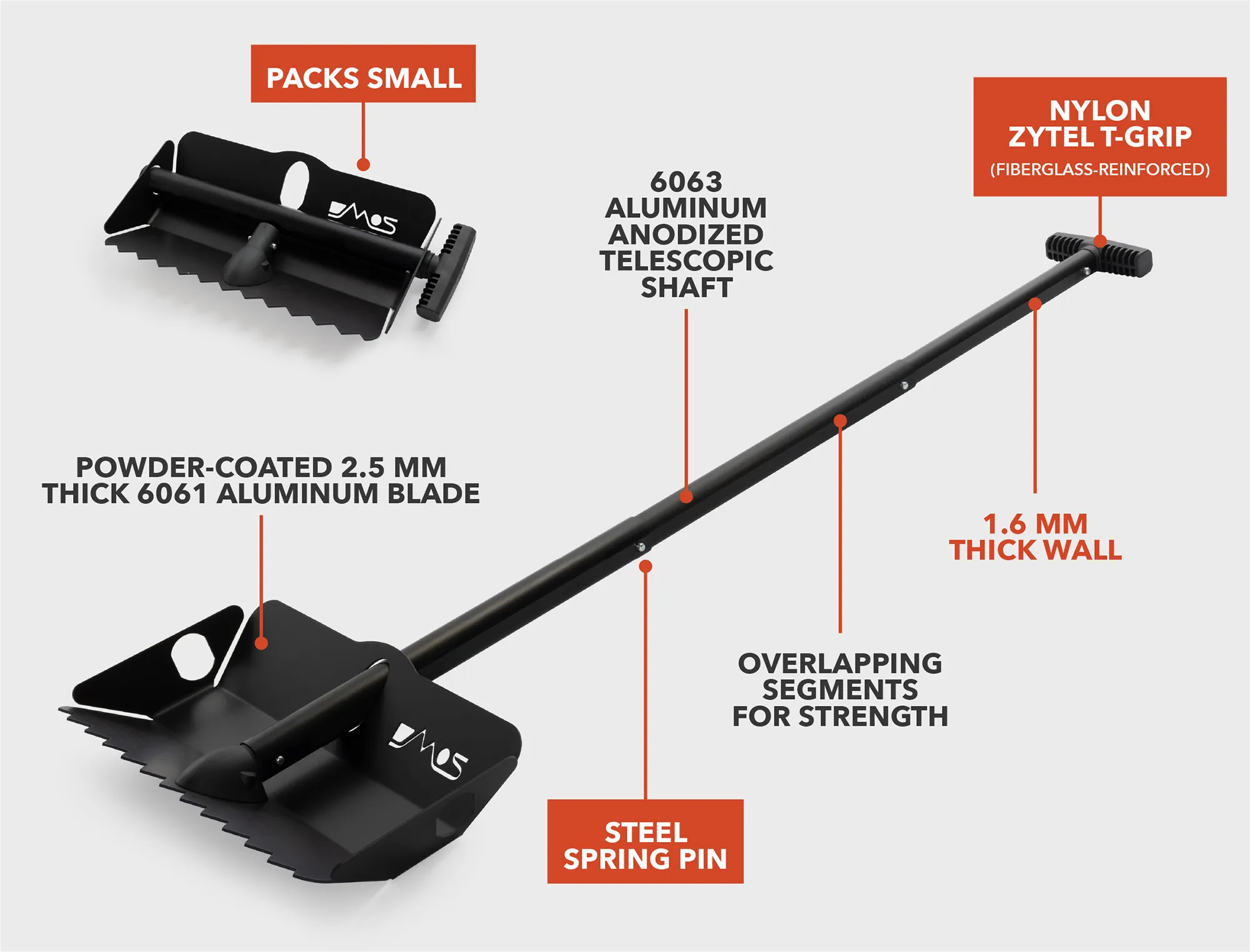
DMOS Stealth Shovel — The Smart Pick
$159.
DMOS makes overland-specific shovels in Bellingham, Washington. The Stealth is their mid-tier flagship and the right pick for 95% of Wrangler owners:
- Folds compact — fits under a JL rear seat or behind the JK back seat
- All-aluminum construction — won’t rust, even after a wet recovery
- Replaceable parts — every piece is field-replaceable; no thrown-out shovels
- Lifetime warranty — DMOS stands behind the construction
The Stealth costs more than a Walmart shovel, less than premium picks, and will last decades of Jeep ownership.
DMOS Delta Pro Shovel — Premium Pick
$349.
DMOS’s flagship. Powder-coat aluminum, larger blade, heavier-duty hinges. This is the “buy once cry once” pick for serious overlanders who use a shovel hard.
For most Wranglers, the Stealth is the right buy. The Delta Pro is the upgrade for users who already broke a cheap shovel and decided they’re done playing.
Mounting
Both DMOS shovels have purpose-built mounts (DMOS sells matching ones) that bolt to roof racks, tire-carrier mounts, and bumper plates. If you’re already running a Front Runner Slimline II or JK pillar-rack system, the mount integrates cleanly.
Section 6 — Winches
A winch is the highest-cost, highest-impact piece of recovery gear you can buy. It’s also the piece you’ll use the least often — most stucks don’t require a winch. But the ones that do require a winch absolutely require it.
If you only wheel with other Wranglers and Land Cruisers, you can probably skip a winch and rely on snatch recoveries. If you ever wheel alone, you need one.
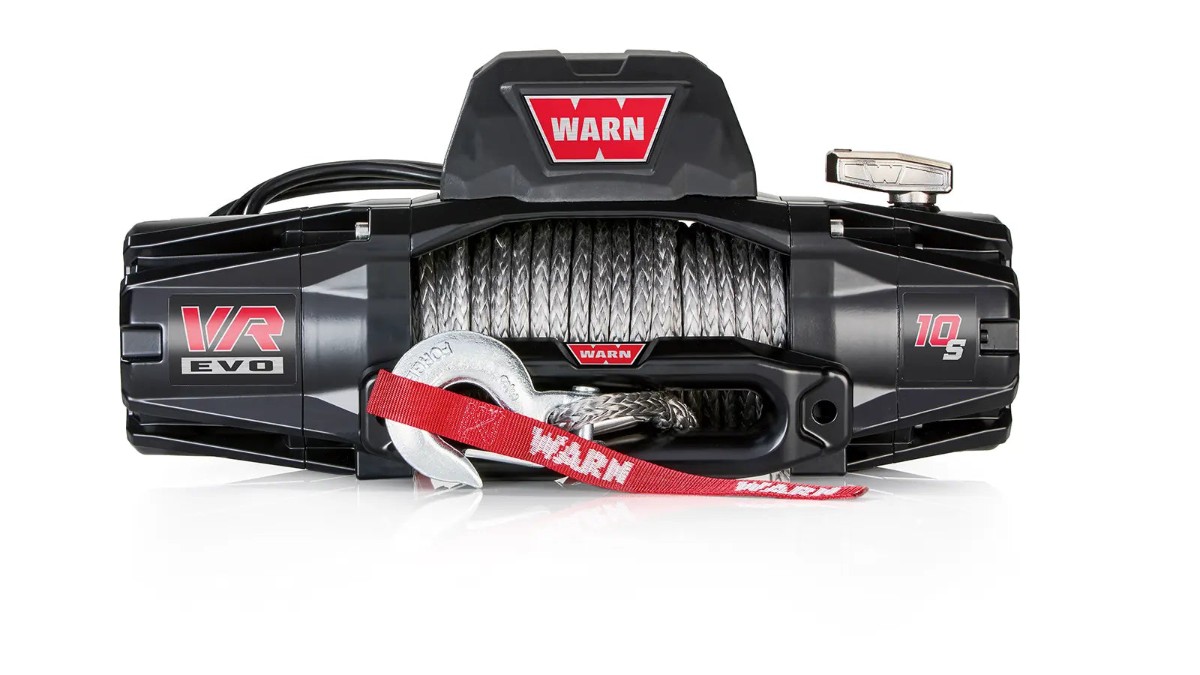
Warn VR EVO 10-S — The Sweet-Spot Pick
~$1,100.
Warn is the gold-standard winch brand. The VR EVO 10-S is the model most Wrangler owners settle on after research:
- 10,000-lb capacity — adequate for a JL or JK at GVWR plus a margin for stuck weight
- Synthetic line — lighter and safer than steel cable; no whipping failure mode
- Sealed motor and controller — submersible-rated for stream crossings
- Plug-and-play with Jeep bumper systems — fits AEV, Smittybilt, Rugged Ridge, Mopar, and most aftermarket bumpers
The VR EVO 10-S is the Warn winch that hits the right balance of performance, price, and current production. It’s the winch most Wrangler upgraders end up with.
Warn ZEON 10-S Platinum — Premium Pick
~$2,200.
If you want the best winch Warn makes, the ZEON Platinum is it. Wireless remote, advanced motor, integrated control box. Twice the price of the VR EVO and not twice as good — but the difference matters if you’re winching weekly or running a heavily-modded JL with bigger tires and accessories.
Warn M8000 — Budget Classic / Lightweight Pick
~$700.
The M8000 is the older but still-in-production Warn workhorse. 8,000-lb capacity, synthetic rope, lighter weight than the 10,000-lb models — which matters more than you’d think on the front of a Jeep, where every pound is over the front axle.
Why it’s still relevant:
- Lightest of the three picks — around 65 lbs versus 80+ for the VR EVO. Easier on stock front suspension.
- Capacity is enough for most JKs — a stock-weight JK at GVWR is well under 8,000-lb working load with a 1.5x safety margin.
- Cheapest entry point to Warn quality — under $700 is rare for Warn synthetic-line winches.
- Field-proven — the M8000 has been in production for decades; you can find parts and service everywhere.
The case against: 8,000-lb capacity is marginal for heavily-loaded JLs or JKs with steel bumpers, tire carriers, and full overland kit. If your Wrangler is at or near 6,000 lbs loaded, get the 10,000-lb VR EVO instead.
For a stock or lightly-modded Wrangler used for weekend overlanding, the M8000 is the right call.
ARB Winch — The Alternative
Available from ARB. ~$1,400.
ARB makes its own winches with similar specs to the Warn VR series. Slightly cheaper than the premium Warn options, and well-integrated with the ARB ecosystem if you’re already running ARB bumpers or recovery gear. The case for ARB over Warn comes down to brand loyalty and ecosystem — both are competent winches.
Warn Hub Wireless Remote
Whatever winch you buy, add the Warn Hub or equivalent wireless remote. Recovering from inside the Wrangler is safer than standing next to a loaded winch line, and once you’ve used a wireless remote you won’t go back to wired.
Section 7 — Pre-Built Recovery Kits
If you don’t want to assemble individual pieces, pre-built kits are the right move. You give up some flexibility in component selection, but you get a coordinated set that fits in a single bag, and the bundled price is usually 15-20% lower than buying the same parts individually.
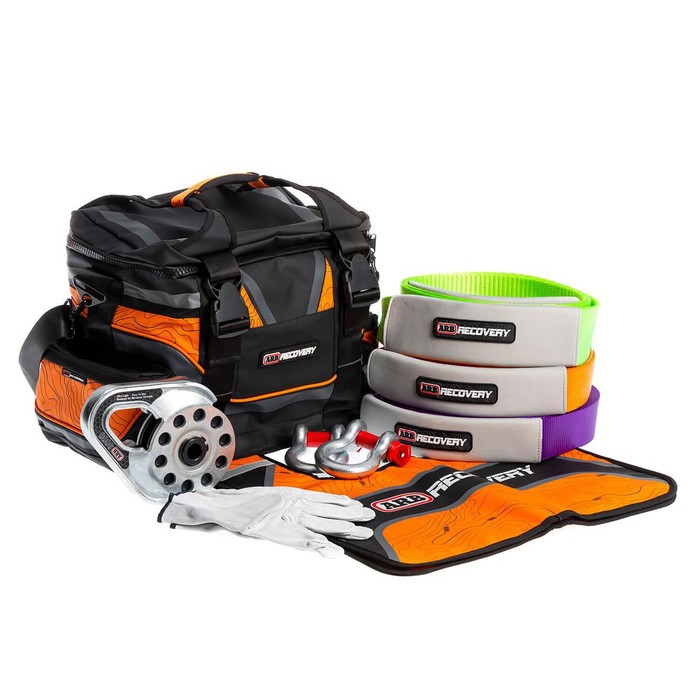
ARB Off-Road Recovery Kit — Best Pre-Built
Available from ARB. ~$300.
ARB’s bundled kits include a 30-foot snatch strap, soft shackles, recovery gloves, a damper blanket, and a duffle bag. Everything you need for snatch-recovery scenarios in a single SKU. The kit is the easiest single-decision recovery purchase a new Wrangler owner can make — open the box, throw it under the back seat, you’re ready for the most common recovery situations.
What’s not in it: recovery boards, kinetic rope, or shovel. Those are separate buys.
Rhino USA Recovery Kit — Value Bundle
Available from Rhino USA. ~$150.
Rhino USA’s bundled kit is the budget alternative to ARB. Recovery strap, soft shackles, gloves, and bag for about half the ARB kit price. Construction is good and the kit is reviewed well by buyers. Pick this if you’re trying to fit a recovery kit into a tight budget.
Recovery Gear by Budget Tier
How to build a working kit at three price points.
Tier 1 — Starter ($300–$400)
- Rhino USA Recovery Kit (~$150)
- Pair of basic ARB or Maxtrax-style boards (~$200)
Adequate for trail-day driving with other vehicles. You can be recovered by another Jeep with this kit. You cannot recover yourself in soft sand without help.
Tier 2 — Mid ($800–$1,000)
- MAXTRAX Xtreme boards (~$450)
- ARB Snatch Strap (~$100)
- Soft Shackles, 2-pack (~$60)
- DMOS Stealth Shovel (~$160)
- ARB Off-Road Recovery Kit (~$300, replaces the standalone strap+shackles)
Now you can self-recover from most situations that don’t require a winch. This is the right kit for ~80% of Wrangler owners.
Tier 3 — Premium ($2,000–$2,500)
- Everything in Tier 2
- Bubba Rope Renegade kinetic rope (~$175)
- Warn VR EVO 10-S winch (~$1,100)
- Warn Hub wireless remote (~$200)
- Factor 55 ProLink (~$120)
This is the full kit. Self-recover from anything short of catastrophic terrain failure. The winch and kinetic rope are the meaningful upgrades from Tier 2.
Mounting & Storage — Where to Put It All
The dirty secret of recovery gear is that half of buying it is figuring out where to keep it. A Wrangler interior is small, and gear stored loose becomes a missile in a rollover.
Recovery boards: Roof rack (vertical brackets), tire carrier mount, or rear-window mount. Don’t carry them loose in the cargo area — they’re heavy and take up the whole floor.
Recovery kits in a bag: Under-seat storage or the cargo molle panel. The ARB kit’s bag fits the JL under-rear-seat area exactly.
Shovel: DMOS sells purpose-built mounts that work on roof racks and tire carriers. If you’re running a Front Runner Slimline II, the Front Runner shovel mount integrates cleanly.
Winch: Mounts to the front bumper plate. Plan on $400-800 in bumper costs to support winch mounting if you don’t already have an aftermarket bumper.
Recovery rope: Bag it, label it, store dry. Wet kinetic ropes lose strength over time if they’re never dried out — the urethane coating slows but doesn’t eliminate moisture absorption.
If you’re running a rooftop tent and an awning, you’ve already got the roof real estate to mount boards and a shovel up top — that’s the cleanest setup for a JK or JL.
Skill > Gear (The Part Nobody Wants to Read)
The most important upgrade to your recovery setup isn’t gear. It’s training.
A trained driver with a $200 recovery kit will out-recover an untrained driver with a $3,000 kit every time. Recovery rope failure modes, snatch-block geometry, anchor selection, and load-direction control are all skills you can’t learn from a YouTube video alone.
Where to get trained:
- Overland Expo workshops — recovery clinics at every Expo (East, West, Mountain West)
- I4WDTA-certified instructors — the International 4WD Trainers Association maintains a list of certified instructors who teach hands-on courses
- Brand-sponsored clinics — ARB, MAXTRAX, and others run periodic free training events at dealer locations
- A local 4WD club — most established clubs have certified instructors who train members for free
Two hours of hands-on training will improve your recovery competence more than any single piece of gear in this guide.
FAQ
How much should I spend on recovery gear for a Wrangler?
Most Wrangler owners should target $800-1,000 total. That gets you Tier 2 in the budget breakdown above — recovery boards, a folding shovel, a snatch strap, and soft shackles. Add a winch ($1,000-2,000) only if you wheel alone or run technical terrain. Below $400, you’re under-equipped for the kind of terrain a Wrangler will take you to.
What’s the single most important piece of recovery gear?
Recovery boards. They solve more real-world stuck situations than any other piece of gear, they work without another vehicle present, and they require zero training to deploy correctly.
Do I need a winch on a Wrangler?
Only if you wheel alone or in remote areas. If you only wheel with other vehicles, a kinetic rope and recovery boards will handle almost everything you’ll encounter. Winches are heavy (35-50 lbs), expensive ($800-2,200), and require a heavy-duty front bumper to mount safely. Buy one if you need it; skip it if you don’t.
Are cheap recovery boards safe?
No. Recovery boards under $150 per pair have documented failure modes that include cracking, flying shards, and tearing tire lugs. The cost difference between cheap boards and MAXTRAX or ARB is the cheapest insurance in the recovery world.
Kinetic rope or snatch strap — which should I buy first?
Snatch strap. It’s cheaper, simpler, and adequate for the most common recoveries. Upgrade to a kinetic rope when you’re doing heavier or steeper pulls regularly.
Where should I store my recovery gear in a JK or JL?
Recovery boards on the roof rack, recovery kit bag under the rear seat, shovel on a purpose-built mount, kinetic rope in a dedicated bag in the cargo area. Avoid storing anything heavy loose — it becomes a projectile in a rollover.
Do I need recovery gear if I only do light off-roading?
If you take your Wrangler off pavement at all, yes. The most common “I just got stuck on a forest road” recoveries are soft mud, washboard sand, and snow — exactly the scenarios recovery boards solve. A $300 set of boards has saved more weekend trips than any other piece of gear.
Should I buy used recovery gear?
No. Recovery rope, straps, and shackles degrade with use and UV exposure in ways that aren’t always visible. A used kinetic rope might be one stretch away from a failure that turns it into a steel-cable-level hazard. Always buy recovery rope new.
Final Recommendation
If you’re starting from zero and want one answer: buy the ARB Off-Road Recovery Kit and a pair of MAXTRAX Xtreme boards. That’s $750, fits in a duffle bag, handles 80% of Wrangler recovery scenarios, and gives you the foundation to add a shovel and kinetic rope later.
If you wheel alone, add a Warn VR EVO 10-S winch and a Factor 55 ProLink. That’s another $1,400 and unlocks the solo-recovery scenarios that a snatch strap and boards can’t solve.
The mistake most Wrangler owners make is over-thinking gear selection while under-investing in training. Buy the kit above, take an Overland Expo or club-sponsored recovery clinic, and you’ll be ahead of 90% of the Wranglers on the trail.
Related Reading
- Best Roof Rack for Jeep JK — Where to mount your recovery boards
- Best Rooftop Tents for Jeep Wrangler — Build out your overland setup
- Best Awning for Jeep Wrangler — The third essential after rack and tent
Recovery starts with knowing where you are. Most stucks happen on unfamiliar routes far from cell service. See our Best GPS Apps for Overlanding guide for the offline navigation apps that keep you oriented when the recovery gets serious.
Deciding between Warn and ARB winches? Our dedicated Warn VR EVO 10-S vs ARB Winch head-to-head covers capacity, warranty, ecosystem, price, and which winch is right for your Jeep Wrangler build.
Deciding between MAXTRAX and ARB TRED Pro? Our dedicated MAXTRAX vs ARB TRED Pro head-to-head covers construction, warranty, visibility, and which recovery board is right for your Jeep Wrangler.
Deciding between Bubba Rope and Yankum? Our dedicated Bubba Rope Renegade vs Yankum Rattler head-to-head covers MBS, warranty, diameter, and which kinetic recovery rope is right for your Wrangler.
Deciding between Warn VR EVO and M8000? Our dedicated Warn VR EVO 10-S vs M8000 head-to-head covers capacity, price, and which Warn winch is right for your Wrangler build.
Serious overland builds need lighting too. Our Baja Designs S8 vs Squadron Pro comparison covers the LED bar vs LED pods decision for Jeep Wrangler lighting.
Adding LED lighting to your overland kit? Our Baja Designs vs Vision X Offroad comparison covers the two premium LED brands and which is right for your Wrangler.
Not building a rig? Rent one instead.
If you want the overland experience but don’t want to own a built-out Wrangler, Moterra Campervans rents luxury 4×4 Mercedes Sprinter vans out of 7 hubs across the U.S. — including Jackson (Grand Teton/Yellowstone), Whitefish (Glacier), SLC and Las Vegas (Utah’s Mighty 5), San Francisco (Yosemite), Seattle (Olympic/Rainier), and Portland ME (Acadia). Everything included: kitchen, heater, solar, pet-friendly. See our full Moterra review for the breakdown.