
✅ Quick Answer
Skip the reading and check current pricing:
🎁 Holiday shopping for a Jeep owner? See our 2026 gift guide for Jeep owners and overlanders — picks from $35 stocking stuffers to rooftop tents.
Updated May 2026 — re-tested and re-priced for 2026 model-year shoppers.
TL;DR — At a Glance
| Best for | Pick | Why | Price | Buy |
|---|---|---|---|---|
| Best overall (best 270°) | Rhino-Rack Batwing | The most-installed batwing on overland rigs in the US. Proven design, integrated mounting kit, ~118 sq ft of coverage in one motion. | ~$849 | Check current price at Rhino-R Check current price at Front R |
| Best premium straight-side | ARB Touring 2500×2500 | Bombproof Aussie build, 300gsm poly-cotton ripstop, integrated 1200-lumen LED light kit. The benchmark for traditional side awnings. | ~$899 | Check current price at Rhino-R Check current price at Front R |
| Best straight-side value | Front Runner Easy-Out 2.0M | The default for any Slimline II rack owner. Fast deploy, modular Front Runner accessory ecosystem, premium build at a third of ARB’s price. | ~$329–449 | Check current price at Rhino-R Check current price at Front R |
| Best 180° | Roofnest Condor Awning Plus | True 180° wraparound coverage, premium fabric, fast setup, integrated LED. | ~$595 | Check current price at Rhino-R Check current price at Front R |
| Best lightweight (most rack-friendly) | Inspired Overland Carbon Fiber 180 | Carbon fiber arms cut weight to ~10 lb. Easy on rack capacity, premium feel. | ~$1,099 | Check current price at Rhino-R Check current price at Front R |
| Most affordable 270° | Yakima MajorShady 270 | The cheapest serious 270° awning on the list. Solid 420D poly-cotton build, 80 sq ft coverage, plug-and-play with Yakima HD Bar / LockNLoad. | ~$799 | Check current price at Rhino-R Check current price at Front R |
| Best for fast deploy | Front Runner Wind Cheater 270 | Sub-45-second deploy, low-profile cassette, integrates with Front Runner Slimline ecosystem. | ~$849 | Check current price at Rhino-R Check current price at Front R |
These Awnings Mount To Your Roof Rack, Not Your Jeep
One thing to clear up first: rooftop awnings attach to your roof rack’s side rails, not to your Jeep’s body or hardtop. That means the awnings on this list fit Wrangler TJ, JK, JL, and JT Gladiator alike — what matters is your rack, not your Wrangler year.
The constraint is whether your rack has the right mounting interface and weight capacity. I cover that for each pick. If you haven’t picked a rack yet, start with the Best Jeep Wrangler JK Roof Rack guide — most awnings here are designed around Front Runner, Rhino-Rack, or Yakima rack systems.
Why You Should Trust This Post
I’ve been overlanding in a 2018 Jeep Wrangler JK for six years. I’ve slept in a Roofnest Eagle, drilled my own roof for a Front Runner Slimline II Extreme, and written the deepest pillar comparisons on the web for both JK roof racks and rooftop tents for Jeep Wrangler.
Honest disclosure on this post: I haven’t personally lived under all 14 awnings here. What you’ll get instead is the most comprehensive cross-brand comparison on the web, drawn from manufacturer specs, owner forums (Expedition Portal, JK-Forum, Reddit r/overlanding), and professional reviews. I’ll be transparent where information is limited or where owners report something different from spec sheets.
FTC disclosure: Some links are affiliate links. I get a small commission at no additional cost to you if you buy through them. I only recommend awnings I’d actually mount on my own JK.
The 3 Awning Styles, In Plain English
Before brands, the most important decision is style. Awnings come in three rough flavors:
Straight-side awnings are the simplest. A telescoping arm extends straight out from the side of your rack, supporting a fabric panel ~6×8 ft. Setup: 1–2 minutes with one person. Coverage: just the side of your vehicle. This is the default starting point — covers ~50 sq ft, cheapest, easiest, fits any rack.
180° wraparound awnings extend from the side AND wrap around to cover the back of the vehicle (or the front, depending on mount side). You get ~75–90 sq ft of coverage and a single corner of full shade no matter where the sun is. More fabric, more poles, slightly more setup time. Best for couples or anyone who cooks at the back of the Jeep.
270° awnings (batwing-style) extend almost three full sides — front, back, and either driver or passenger side — for ~100–150 sq ft of coverage. The deploy is faster than 180° (one motion, gas-strut or self-supporting), but the awning itself is heavier and pricier. Best for groups, family camping, or anyone who hangs out at camp for hours and wants total shade flexibility regardless of sun position.
Quick rule of thumb: Solo or fast camp setup → straight-side. Couple, cook at the back → 180°. Group, base camp, follow-the-shade → 270°.
Want a deeper dive on the 270° vs 180° decision? See 270 vs 180 Awning: Which Is Right for Your Jeep Wrangler? — coverage diagrams, weight tradeoffs, setup time, and a “pick X if you…” decision matrix.
How to Choose: Decision Framework
Beyond style, four other factors:
1. Rack compatibility. Most awnings ship with brackets for Front Runner Slimline, Rhino-Rack Pioneer, or Yakima HD rails. Some require a universal mount adapter. Check this before buying — every awning section below notes what works.
2. Weight. A 270° batwing awning runs 35–55 lb. Straight-side is 15–25 lb. If you’re stuck with a 165 lb dynamic-rated rack (Yakima RibCage, Rhino-Rack Pioneer), and you’ve already mounted a 130–150 lb rooftop tent, the awning might push you over.
3. Material and durability. Premium awnings use 280–420g/sqm ripstop polyester or polycotton with PU coating. Budget awnings use lighter (~210g) fabric. The difference shows up in 5-year UV degradation and mildew resistance, not day one.
4. Mounting orientation. Driver side or passenger side? Your camp setup, your cookspace, and where you park your Jeep all factor in. Most awnings are sold in either-side-mountable configurations; some (especially 270° models) come in left-or-right-specific SKUs.
Section 1: Premium Tier ($800–$1,500)
These are the awnings the serious overlander brands compete on. Best fabric, best hardware, best long-term durability, premium pricing.
1. ARB — The Benchmark Premium Straight-Side
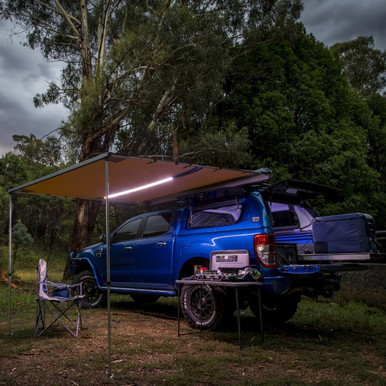
ARB has been building gear for Australian outback expeditions since the 1970s — their build standards are calibrated for desert UV and hard use over years.
ARB doesn’t make a 270° awning (yet — they sell brackets for third-party 270° units mounted to their BASE Rack). What they do make is the gold standard linear awning: the Touring series. Sized 2.5m × 2.5m or 2.0m × 2.5m, with a built-in 1200-lumen LED light kit, 300gsm PU-coated poly-cotton ripstop canvas, 25mm aluminum poles, and 1000mm rated water-head waterproofing. Welded and heat-taped seams. UPF 50+.
If you want a straight-side awning that lasts a decade through every climate and you don’t mind spending for it, this is the answer.
Featured models:
ARB Touring 2500×2500 with Light Kit — full-size 2.5m × 2.5m coverage, integrated 1200-lumen LED. ~24 lb. ~$899.
ARB Touring 2000×2500 with Light Kit — 2.0m × 2.5m, slightly smaller footprint, same premium build. ~$799.
Pros: Best-in-class fabric and hardware. Integrated LED is genuinely useful. PU-coated 300gsm canvas handles heavy rain and harsh UV better than standard 210D ripstop. Long dealer/service network in the US.
Cons: No 270° option in the lineup. Premium price for a straight-side awning. Linear coverage only — no wraparound shade.
2. Front Runner — Best Slimline-Rack Ecosystem Awnings
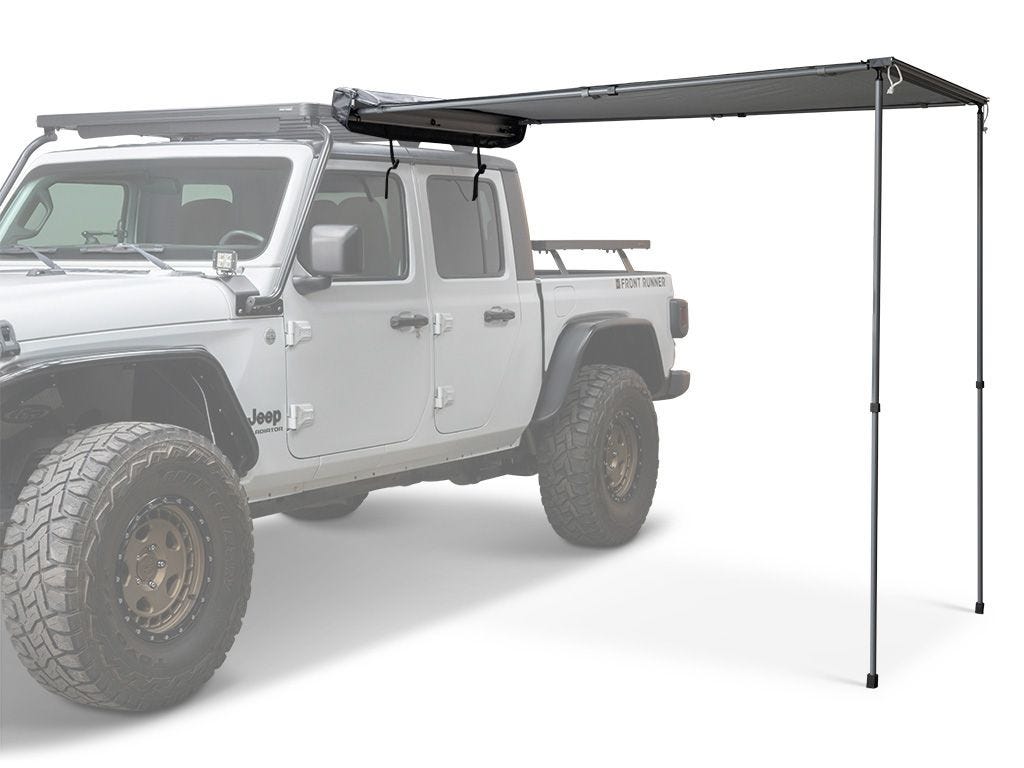
Check current price at Front Runner (via Dometic) →
The South African expedition-rack maker most JK owners already buy from. Front Runner’s awnings are designed to integrate with their Slimline II rack ecosystem — but they also fit other racks with adapter kits.
Note: Front Runner was acquired by Dometic in 2022. The product line and quality remain the same; the affiliate link goes through Dometic now.
Featured models:
Easy-Out 2.0M Awning — Front Runner’s most popular awning. 6.6 ft wide × 6.9 ft extension, 27.6 lb, 400D oxford/polyester PU-coated ripstop, UVP 50+, 1500mm water-resistance. ~$329–449.
Wind Cheater 270° Awning — Front Runner’s 270° entry. Lower-profile cassette than Rhino-Rack Batwing, premium hardware. ~$849.
Pros: Modular accessory ecosystem (walls, lights, mounting brackets). Integrates seamlessly with Front Runner Slimline racks. Premium fabric. Reasonable pricing for the premium tier.
Cons: Mounts work best with Front Runner racks; adapters required for others. Wind Cheater 270 is heavier than the (nonexistent) ARB equivalent.
3. James Baroud — European Premium Build
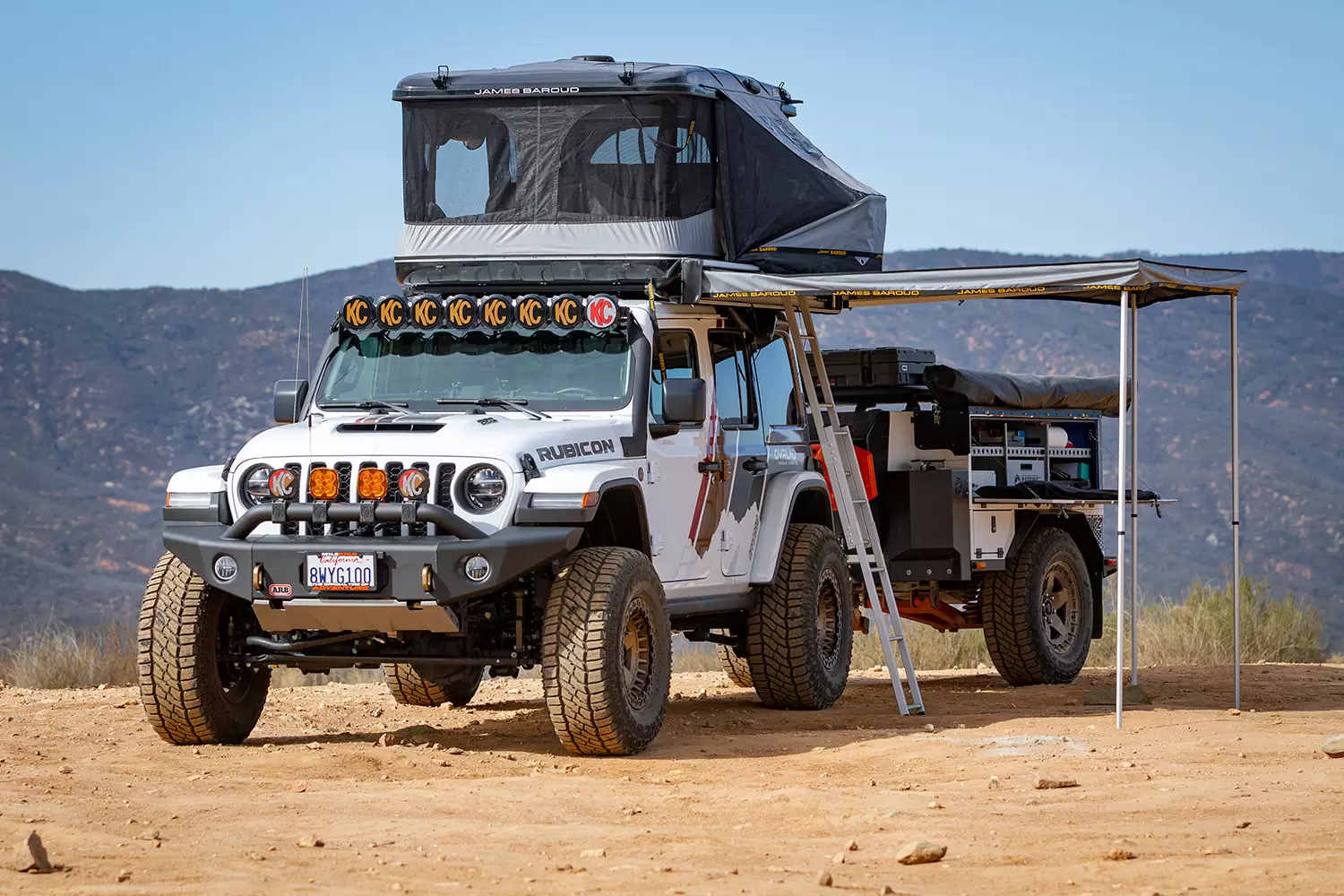
Check current price at James Baroud →
The Portuguese fiberglass-tent brand carries their premium build philosophy into their awning line. Aluminum and fiberglass hardware, integrated LED options, European refinement.
James Baroud awnings are typically sold as accessories to their tent ecosystem (Discovery, Vision, Odyssey) but mount to any compatible rack. They’re less common in the US than ARB or Front Runner — fewer dealers, longer shipping — but the build is in the same premium tier.
Featured models: James Baroud 270° Awning and Linear Side Awning. Pairs perfectly with James Baroud Discovery, Vision, and Odyssey tents.
Pros: Premium European build. Pairs perfectly with James Baroud tents. Aluminized polyester fabric is more weather-resistant than standard ripstop.
Cons: Smaller US dealer network. Pricier than US-market equivalents. Color/style options are limited.
4. Inspired Overland — The Lightweight Outlier
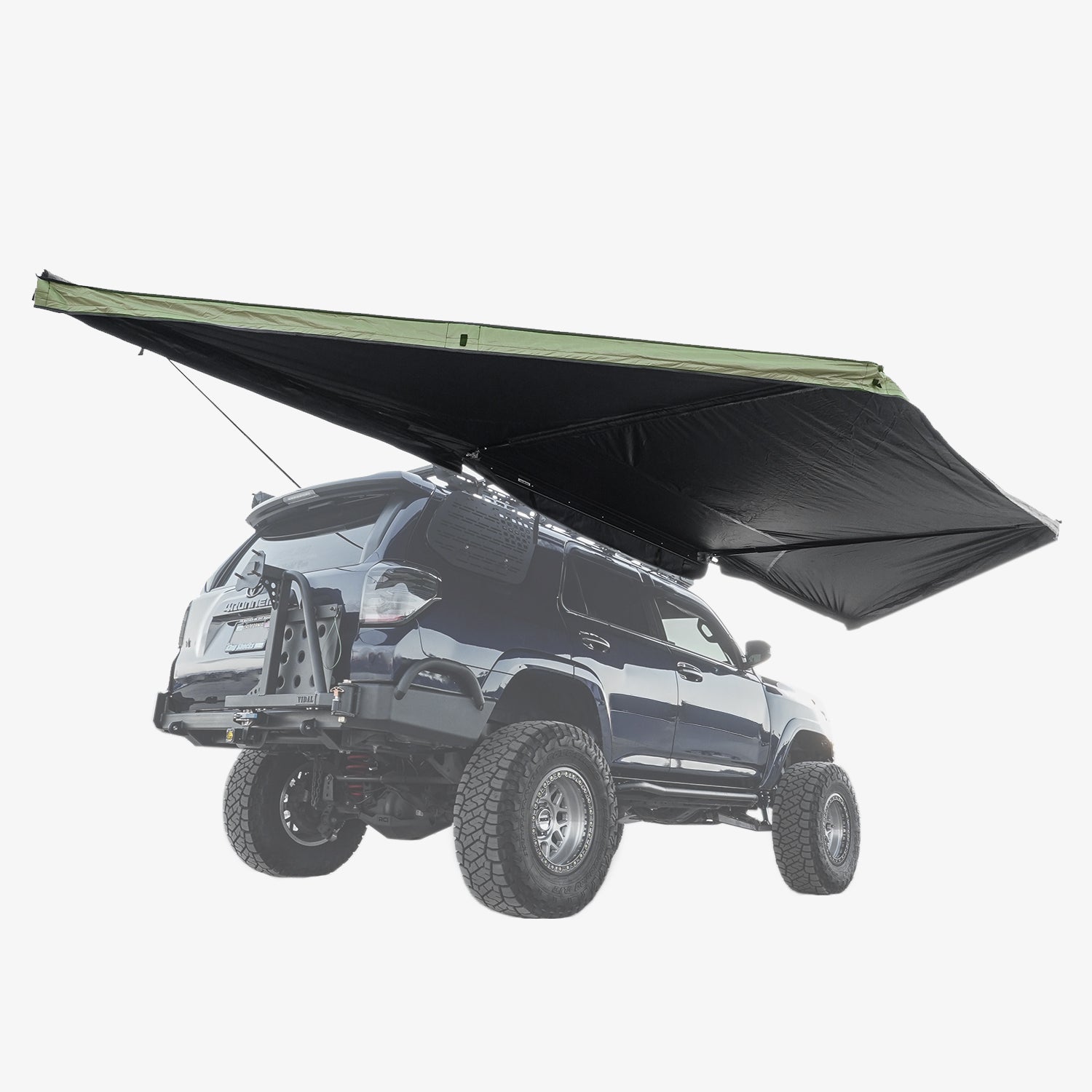
Check current price at Inspired Overland →
The lightweight outlier. Inspired Overland makes a carbon-fiber-armed 180° awning that weighs ~10 lb total — one-third the weight of an aluminum 180°.
This is the pick for anyone fighting rack capacity. If you’re running a Yakima RibCage (165 lb dynamic) with a 150 lb rooftop tent and gear, a 35 lb aluminum awning blows your budget. A 10 lb carbon fiber awning fits comfortably under the limit.
Featured model: Carbon Fiber 180 Awning — ~10 lb, premium fabric, 180° wraparound coverage. ~$1,099.
Pros: Lightest 180° awning available, by a wide margin. Premium carbon fiber feels right at this price point. Fits where heavier awnings can’t.
Cons: Highest price-per-square-foot of coverage on this list. Carbon fiber arms can be more brittle in extreme cold than aluminum. Newer brand — less long-term durability data.
Section 2: Mainstream Tier ($400–$900)
The competitive middle of the market. Solid construction, reasonable pricing, broader brand recognition.
5. Rhino-Rack — The Iconic Batwing Maker
Check current price at Rhino-Rack →
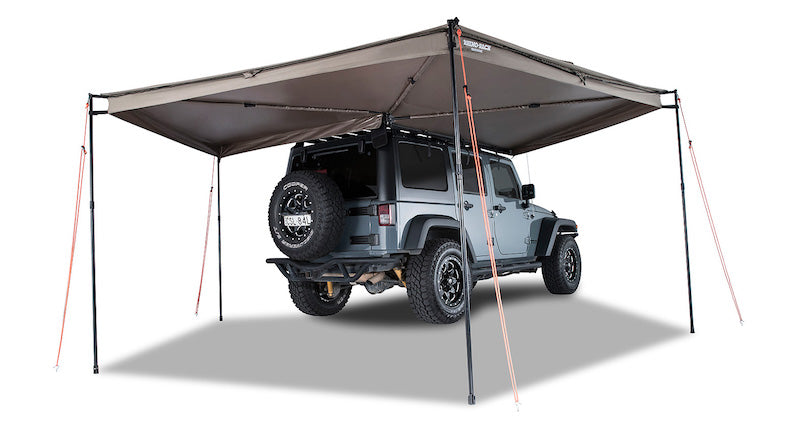
Australian rack and accessory maker that pioneered the Batwing 270° design. Probably the most-installed batwing on overland rigs in the US.
Featured models:
Batwing Awning — the iconic 270° design. Driver-side or passenger-side SKUs. 118 sq ft of UPF 50+ coverage, aluminum legs adjustable to 7.5 ft, ~48 lb (rack-mounted). ~$849. The Freestanding version (~70 lb) adds detachable poles for camp use without the vehicle.
Sunseeker 2.5M — straight-side awning, 2.5m extended length, integrates with Rhino-Rack Pioneer system. ~$429.
Foxwing — 270° smaller-footprint cousin to the Batwing, lighter and easier to mount on smaller racks. ~$749.
Pros: Massive installed base means lots of owner reports and aftermarket compatibility. Tested extensively in Australian outback. Pioneer rack ecosystem integration.
Cons: Batwing is heavier than the Front Runner Wind Cheater. Sunseeker fabric is good but not premium-tier.
6. 23 Zero — Australian Engineering for Harsh Conditions
Check current price at 23 Zero →
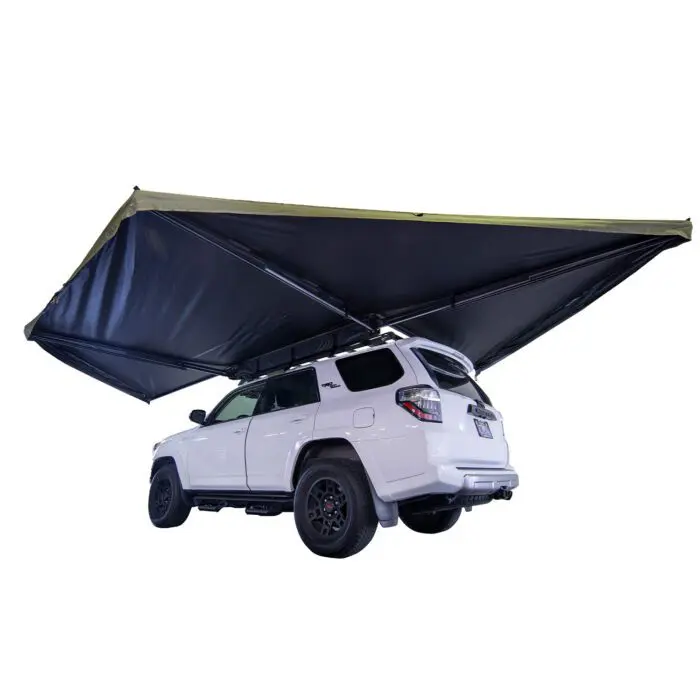
Australian brand with a strong 270° lineup. 23 Zero leans into innovative materials and weather-extreme construction.
Featured models:
Peregrine 270 — 23 Zero’s flagship 270° awning. Premium fabric, gas-strut deployment.
Peregrine 180 — 180° version of the Peregrine, same fabric and construction.
Pros: Solid 270° at a price often below ARB equivalent setups. Australian engineering for harsh conditions. Pairs well with 23 Zero tent line (Kabari Superfly etc.).
Cons: Smaller US dealer presence than Rhino-Rack. 270° gets compared less favorably to ARB by reviewers.
7. Roofnest — Best Tent-Ecosystem Integration
Check current price at Roofnest →
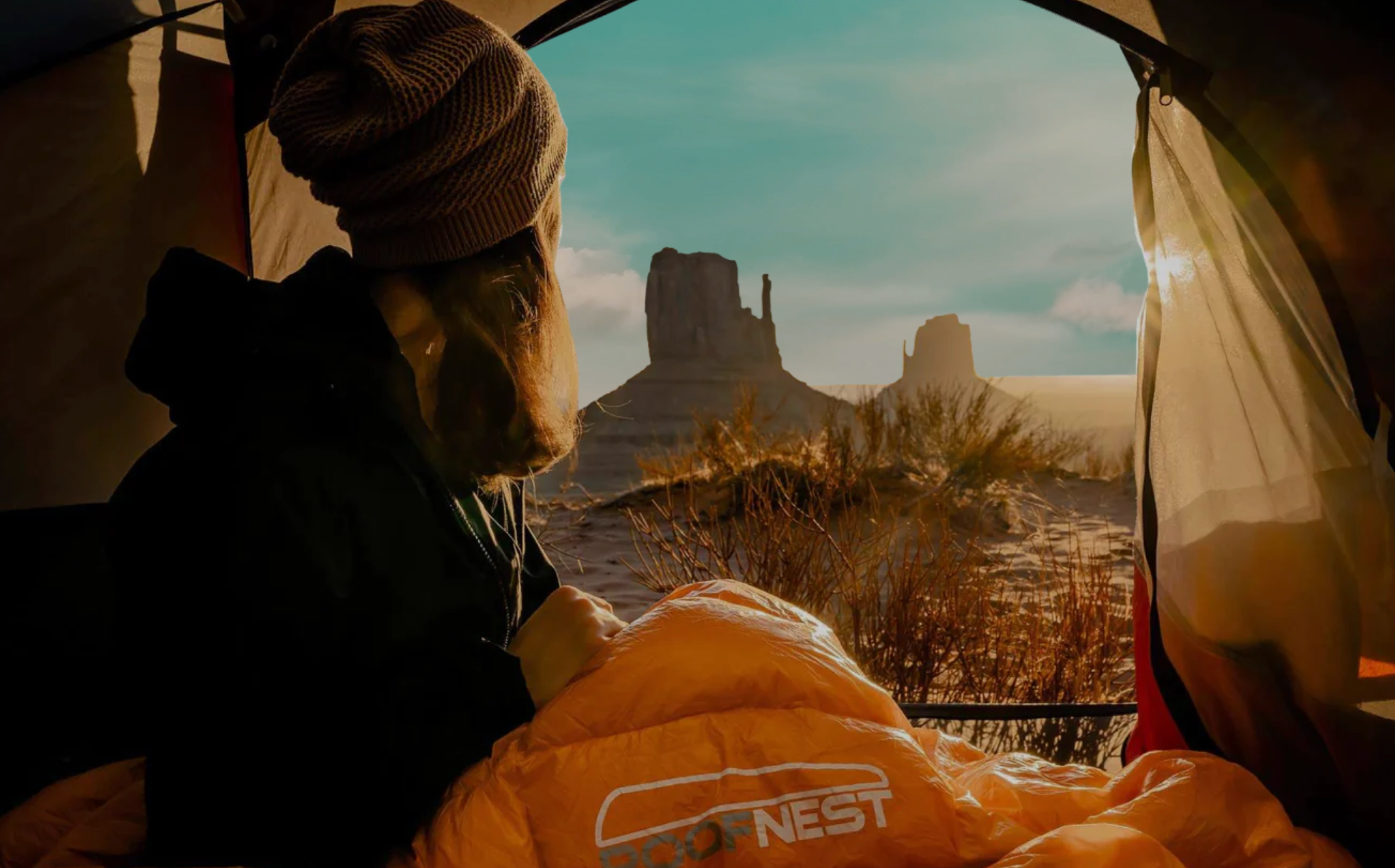
The Colorado rooftop tent brand has a small but well-thought-out awning line. Designed to integrate with their Falcon and Condor tent series.
Featured models:
Condor Awning Plus — 180° wraparound, integrated LED lighting, premium fabric. ~$595.
Sandcastle Awning — straight-side budget option for Roofnest tent owners. ~$349.
Pros: Integrates seamlessly with Roofnest tent ecosystem. Roofnest customer service is genuinely best-in-class — they’ll replace a torn awning panel without arguing. Fast setup, well-made.
Cons: Smaller awning lineup than ARB or Rhino-Rack. Mounting options may require adapters for non-Roofnest setups.
8. iKamper — One Awning, Built Right
Check current price at iKamper →
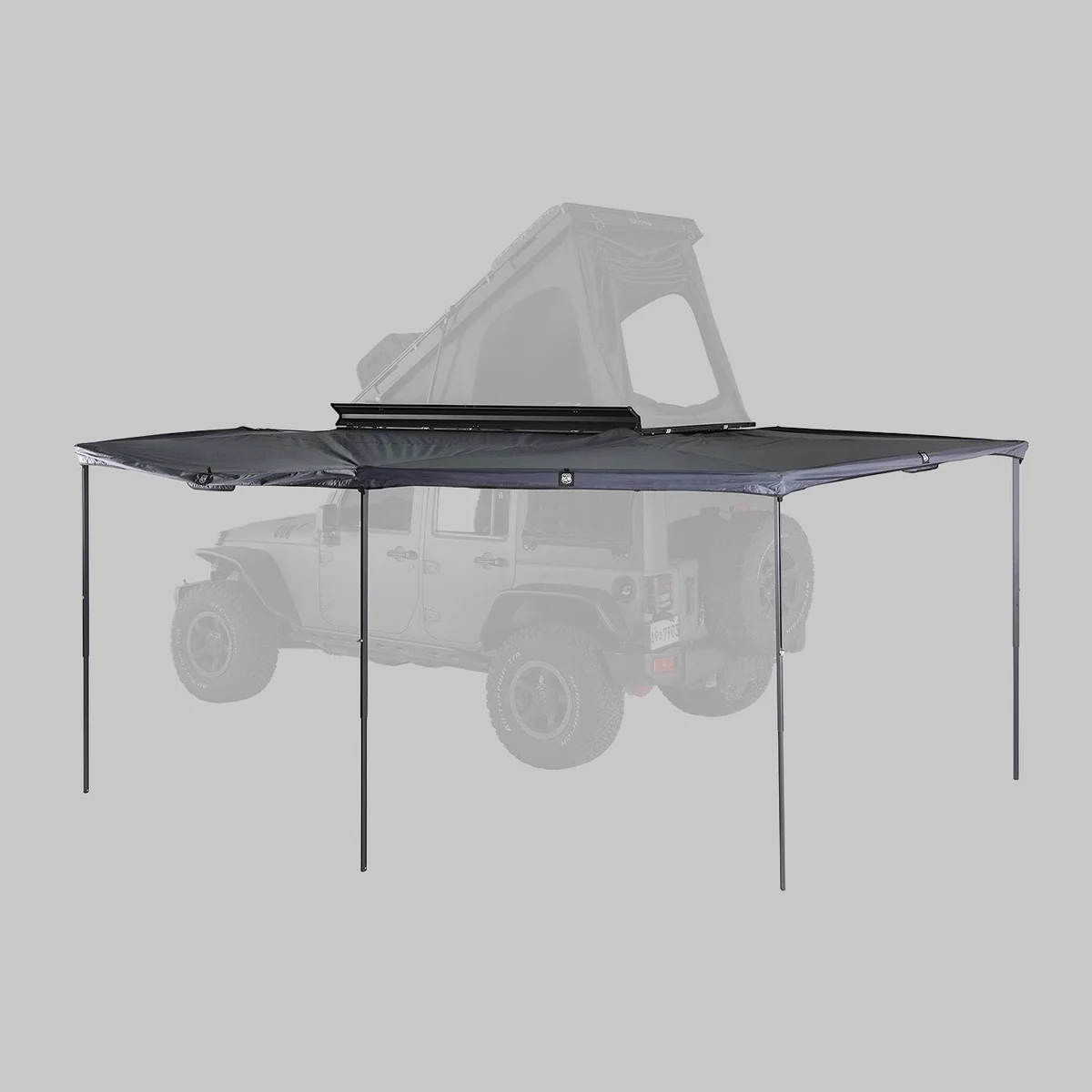
iKamper makes one awning — the AOK 180 — and they make it well. Same fiberglass premium build philosophy as their Skycamp tents.
Featured model: AOK Awning — 180° wraparound, premium iKamper construction, integrates with Skycamp series tents. ~$700.
Pros: iKamper build quality. Designed to pair with their tent series. Fewer moving parts than most 180° awnings (more reliable long-term).
Cons: Only one model in the lineup — no straight-side or 270° option. Pricier than competing 180° awnings.
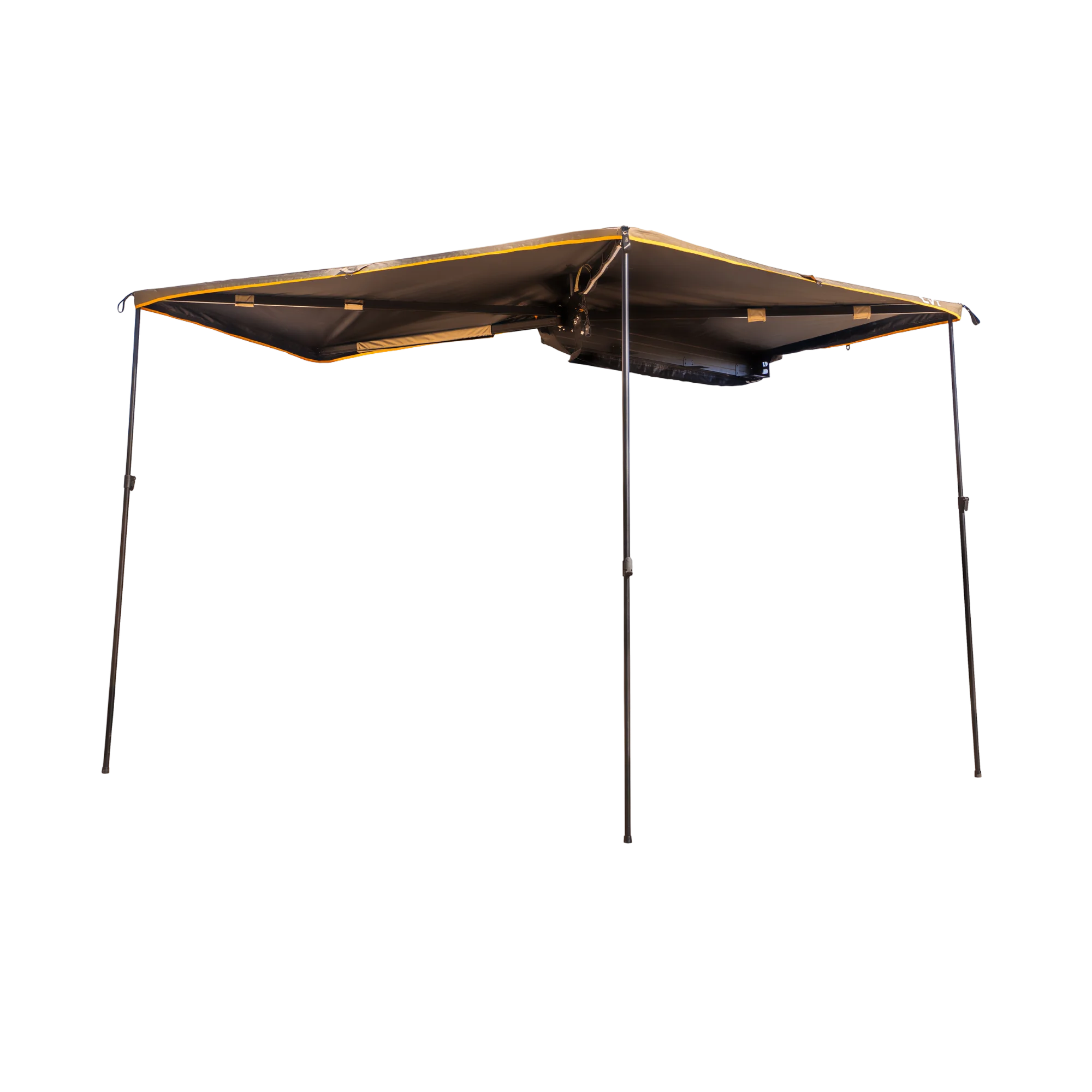
9. Cascadia (CVT) — Pacific Northwest Steady
Check current price at Cascadia →
Long-running Pacific Northwest brand (now part of the Tepui/Thule family). Their awning line is straightforward — solid construction, fair pricing, broad rack compatibility.
Featured models: Straight-side and 270° awnings, both well-made and broadly rack-compatible.
Pros: US-based brand with US dealer support. Decent pricing. Compatible with broad rack range.
Cons: Less brand differentiation than ARB or Rhino-Rack. Lower visibility among newer overlanders.
Section 3: Mid-Tier / Specialty ($350–$700)
Smaller brands punching above their weight or with distinctive product takes.
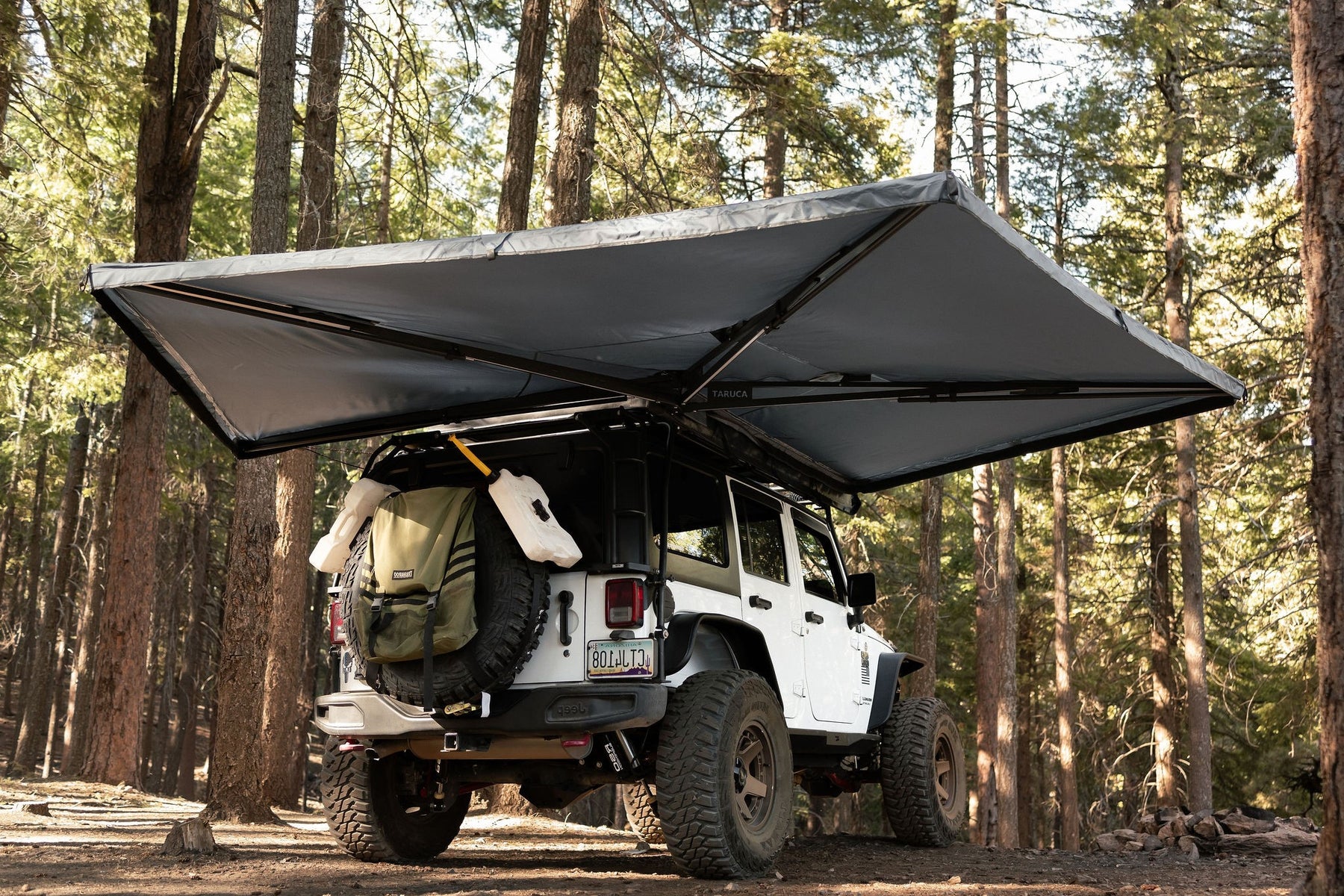
10. TARUCA — Premium Niche Australian
Check current price at TARUCA →
Specialty Australian brand making premium 270° awnings with their own engineering twist. Lightweight aluminum hardware, premium fabric, niche but growing US presence.
Featured model: TARUCA 270° Awning — premium materials, distinctive Australian engineering.
Pros: Distinctive Australian engineering. Premium materials. Smaller production runs mean better quality control.
Cons: Limited US dealer presence. Newer brand — fewer long-term owner reports.
11. FSR (Free Spirit Recreation) — Made-in-USA Tent-Match
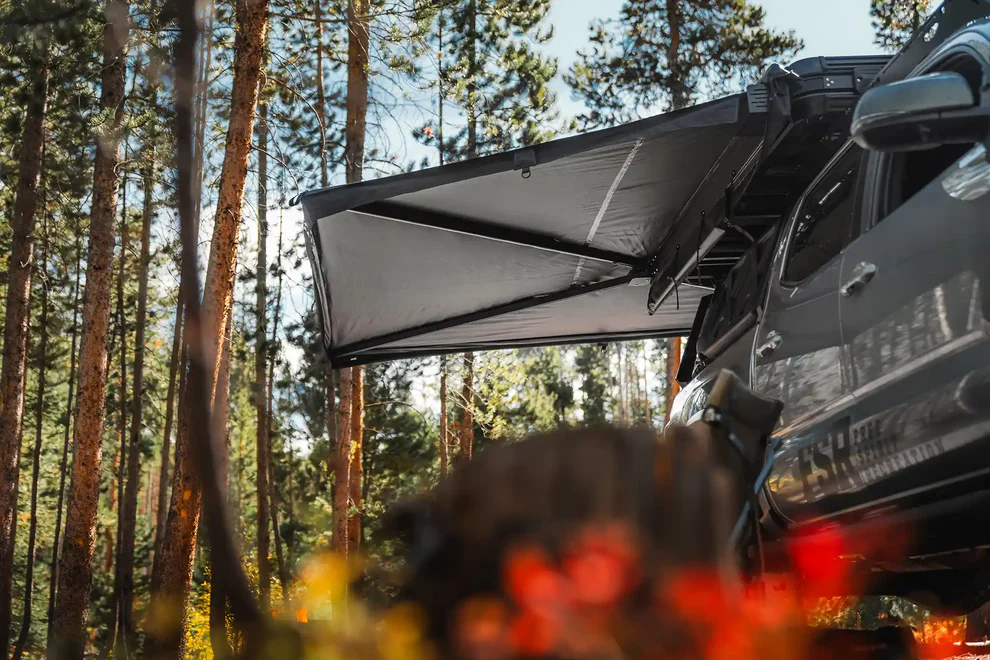
Colorado tent brand with a small awning lineup focused on integration with their Aspen Pro and Kali tent lines.
Featured model: FSR side awning — pairs with FSR tent series, Made in USA.
Pros: Pairs perfectly with FSR tents. Made in USA. Solid build.
Cons: Limited model selection. Lower brand awareness in awning category.
12. ROAM Adventure Co — Bend, Oregon Clean Design
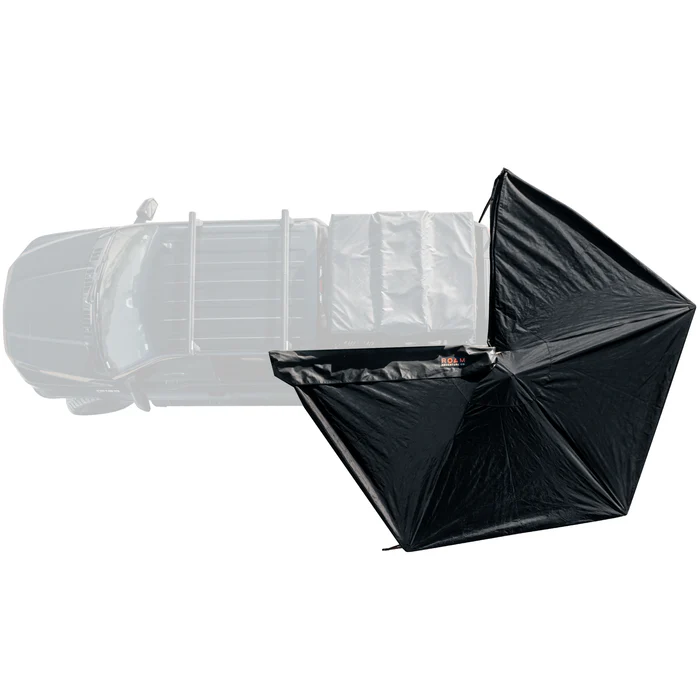
Bend, Oregon brand making solid mid-tier awnings with a clean aesthetic and reasonable pricing.
Featured models: ROAM Rugged Case Awning (6×8ft straight-side with hardshell case, ~$549) and ROAM 270 Awning.
Pros: Clean modern design. Hardshell case protects fabric. US-based brand.
Cons: Smaller dealer network. Limited model range.
Section 4: Value Tier ($300–$500)
Budget options that get the job done. Lighter fabric, simpler hardware, but solid for occasional/three-season use.
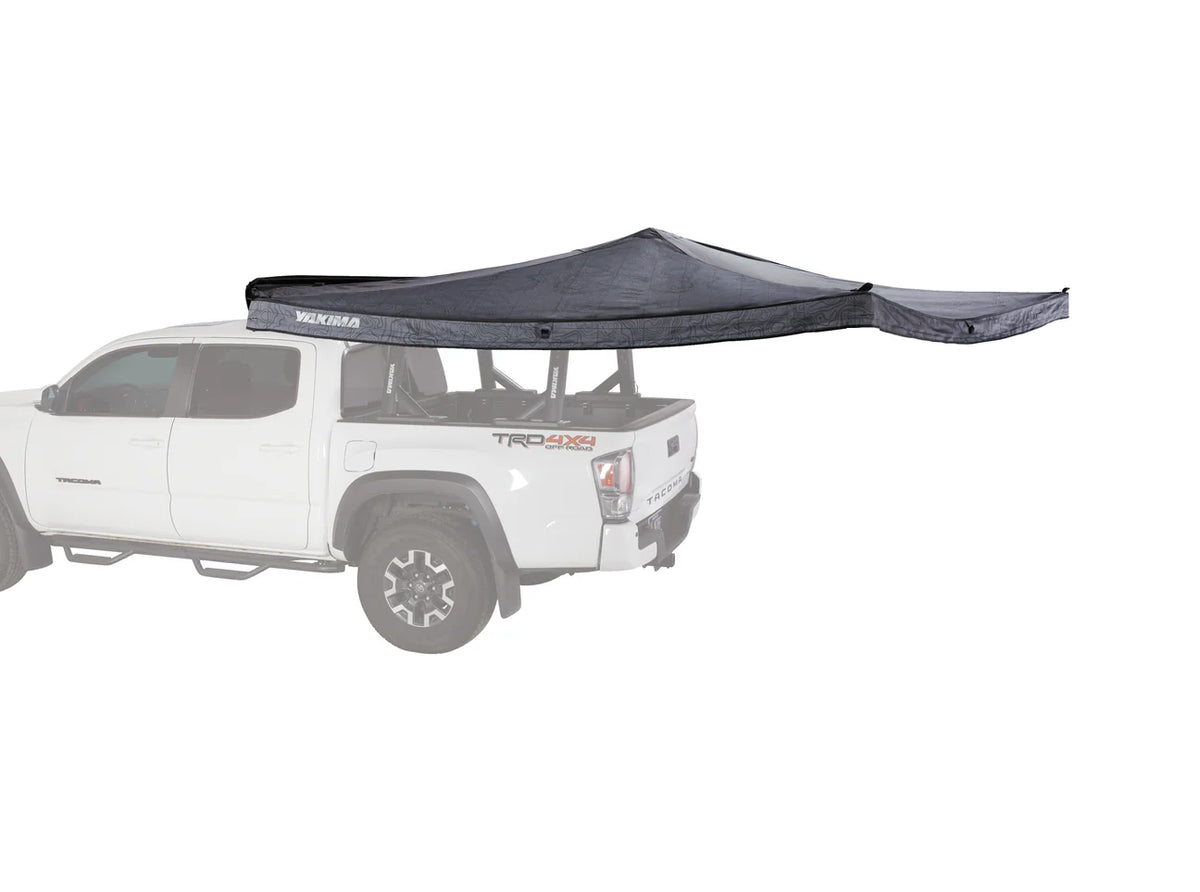
13. Yakima — The Affordable 270° Maker
Check current price at Yakima →
Mainstream rack brand entering the awning space at value pricing. Their MajorShady 270 brought 270° awnings to under $800.
Featured models:
MajorShady 270 — Yakima’s value-tier 270°. 80 sq ft coverage, 46.5 lb, 420D poly-cotton PU-coated fabric, T-slot mounts to Yakima HD Bar, JetStream, LockNLoad. ~$799 (sometimes on sale to $699).
SlimShady — Straight-side awning, ultra-compact mounting. ~$249.
Pros: Cheapest 270° on this list. Wide US distribution (REI, Yakima dealers). Plug-and-play with Yakima HD towers and LockNLoad rails.
Cons: Lighter fabric than ARB/Rhino. Not as durable in long-term UV. Mostly designed for Yakima rack ecosystem.
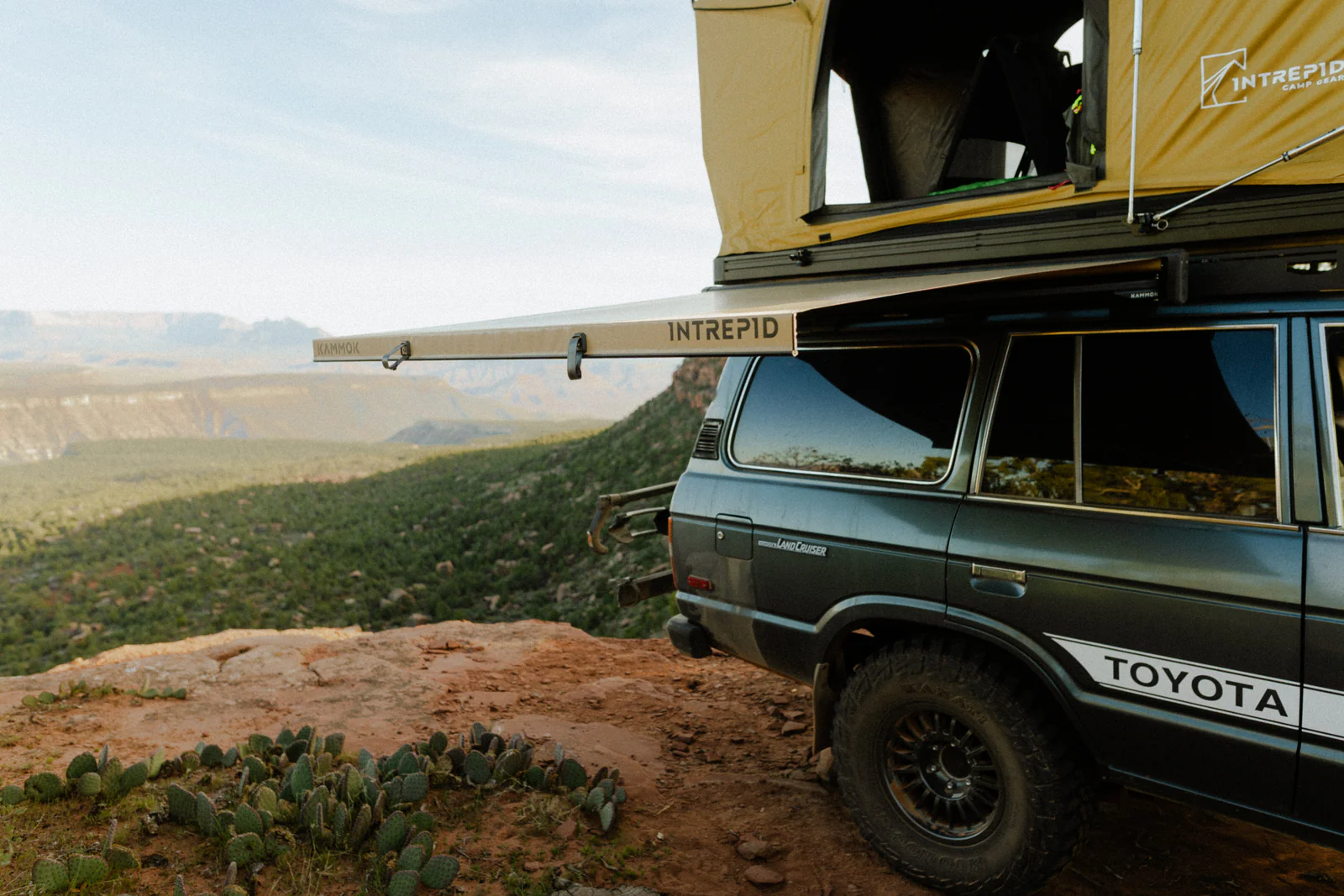
14. Intrepid Camp Gear — Tent-Ecosystem Value
Check current price at Intrepid Camp Gear →
New entrant making affordable awnings as a complement to their Geo rooftop tent line.
Featured model: Intrepid Vehicle Awning — straightforward construction, complements Geo 3.0 Pro tent for a value-tier camp setup.
Pros: Pairs well with Geo 3.0 Pro rooftop tent for the full value-tier camp setup. 3-year warranty.
Cons: Newer brand, less long-term durability data. Limited model lineup.
Full Comparison Table
| Awning | Style | Coverage | Weight | Setup | Price | Buy |
|---|---|---|---|---|---|---|
| ARB Touring 2500×2500 (linear) | Straight | ~65 sq ft | ~24 lb | 60 sec | ~$899 | Check Price |
| ARB Touring 2000×2500 (linear) | Straight | ~52 sq ft | ~22 lb | 60 sec | ~$799 | Check Price |
| Front Runner Easy-Out 2.0M | Straight | ~46 sq ft | 27.6 lb | 60 sec | ~$329–449 | Check Price |
| Front Runner Wind Cheater 270 | 270° | ~140 sq ft | ~48 lb | 45 sec | ~$849 | Check Price |
| James Baroud 270° | 270° | TBD | TBD | 30 sec | TBD | Check Price |
| Inspired Overland Carbon Fiber 180 | 180° | ~85 sq ft | ~10 lb | 90 sec | ~$1,099 | Check Price |
| Rhino-Rack Batwing (rack-mounted) | 270° | 118 sq ft | ~48 lb | 45 sec | ~$849 | Check Price |
| Rhino-Rack Sunseeker 2.5M | Straight | ~50 sq ft | ~18 lb | 60 sec | ~$429 | Check Price |
| Rhino-Rack Foxwing | 270° (compact) | ~120 sq ft | ~36 lb | 45 sec | ~$749 | Check Price |
| 23 Zero Peregrine 270 | 270° | ~140 sq ft | TBD | 45 sec | TBD | Check Price |
| Roofnest Condor Awning Plus | 180° | ~80 sq ft | TBD | 60 sec | ~$595 | Check Price |
| iKamper AOK Awning | 180° | ~85 sq ft | TBD | 60 sec | ~$700 | Check Price |
| Cascadia 270 Awning | 270° | TBD | TBD | TBD | TBD | Check Price |
| TARUCA 270° | 270° | TBD | TBD | TBD | TBD | Check Price |
| FSR side awning | Straight | TBD | TBD | TBD | TBD | Check Price |
| ROAM Rugged Case Awning | Straight | ~50 sq ft | ~25 lb | 60 sec | ~$549 | Check Price |
| Yakima MajorShady 270 | 270° | 80 sq ft | 46.5 lb | 60 sec | ~$799 | Check Price |
| Yakima SlimShady | Straight | ~35 sq ft | ~14 lb | 60 sec | ~$249 | Check Price |
| Intrepid Vehicle Awning | TBD | TBD | TBD | TBD | TBD | Check Price |
Rear Awnings for Jeep Wrangler
Want shade off the back of the Jeep, where the tailgate and kitchen are? You have three ways to get it:
- A 270° awning wraps around the side and the rear in one unit — the easiest way to cover the tailgate. The Rhino-Rack Batwing is our top 270° pick for Wranglers.
- A straight awning mounted on the rear of your rack — most rack makers sell awning brackets that bolt to a rear crossbar or the back edge of a platform. Make sure the awning’s length clears the spare tire when it’s rolled up.
- A tailgate shelter — a fabric shelter that attaches around the open rear of the Jeep. Cheap and no rack needed, but it covers far less area.
Jeep Awning Without a Roof Rack: Your Options
Every awning in this guide mounts to a roof rack, and that’s the right way to do it. Fiberglass hardtops aren’t designed to have awnings bolted straight to them. If you don’t want a full rack, here’s what Jeep owners actually do:
| Option | How it works | Trade-offs |
|---|---|---|
| Crossbars only | Gutter-mount or hardtop crossbars give the awning brackets something to bolt to without a full platform | Check the bars’ load rating; 270° awnings are heavy and need sturdy mounts |
| Strap or suction-cup side awnings | Lightweight car-side awnings that attach with straps, suction cups, or door-frame hooks | Set up and taken down every stop; not built for wind or highway driving |
| Tailgate shelter | Fabric shelter around the open rear | Small coverage; good for cooking at the tailgate |
| Freestanding canopy | A pop-up shade canopy set up next to the Jeep | Cheapest, no mounting at all; bulky to carry and catches wind |
If you camp more than a few weekends a year, a basic rack plus a real awning is the better long-term setup. See our Jeep roof rack guide.
Jeep Awning vs Canopy: What’s the Difference?
“Jeep canopy” can mean two different things, so it’s worth sorting out before you buy:
- A vehicle awning (this guide) rolls out from the side or back of the Jeep for shade and rain cover at camp. It’s permanently mounted and deploys in under a minute.
- A freestanding canopy is a pop-up shade tent you set up separately. It’s cheaper and works with any vehicle, but it’s slower to set up, takes cargo space, and needs staking in wind.
- A cabin sunshade (often sold as a mesh top or bikini top) covers the inside of the Jeep when you drive with the roof off. It’s a different product — it shades passengers while driving, not your campsite.
Frequently Asked Questions
Can you put an awning on a Jeep without a roof rack?
Yes, but options are limited. You can mount an awning to gutter-mount or hardtop crossbars, use a strap or suction-cup car-side awning, or use a tailgate shelter or freestanding canopy. Don’t bolt an awning directly to a fiberglass hardtop.
What is the best rear awning for a Jeep Wrangler?
A 270-degree awning like the Rhino-Rack Batwing covers both the side and the rear in one unit, which is the easiest way to shade the tailgate. A straight awning on a rear-mount bracket is a cheaper alternative.
What is the difference between a Jeep awning and a canopy?
A Jeep awning mounts to the roof rack and rolls out from the vehicle in under a minute. A canopy is usually a freestanding pop-up shade you set up separately. A mesh sunshade or bikini top shades the cabin while driving with the roof off.
Will an awning fit my Jeep Wrangler?
Yes — awnings mount to your roof rack, not your Wrangler directly. Any awning on this list will fit a TJ, JK, JL, or JT Gladiator with a compatible rack. The fitment question is “what rack are you running?” not “what year is your Jeep?”
What’s the difference between 270°, 180°, and straight-side?
Coverage area and setup complexity. Straight = ~50 sq ft of one-side shade. 180° = ~85 sq ft wrapping around the back. 270° = ~120–150 sq ft wrapping around 3 sides. More coverage means heavier and pricier.
How much weight can my rack hold for an awning?
Most racks are rated for static weight (parked) and dynamic weight (driving) separately. A 50 lb 270° awning is well within static capacity but can flirt with the dynamic limit on rate-limited racks (Yakima RibCage, Rhino-Rack Pioneer at 165 lb dynamic). If you’ve already mounted a 150 lb tent, calculate carefully. See the JK roof rack guide for rack capacity details.
270° vs 180° — which should I get?
180° if you camp solo or as a couple and mostly cook at the back of the Jeep. 270° if you camp with a group, base-camp for multiple nights, or want full shade flexibility regardless of sun position. 270° is more setup, more weight, and 50–100% more money — pay for it only if you’ll use the extra coverage.
Are these awnings waterproof?
Most premium awnings (ARB, Front Runner, James Baroud, Rhino-Rack) are built with PU-coated fabric rated 1500–3000mm hydrostatic head — fully waterproof for serious rain. Budget awnings (Yakima SlimShady, Intrepid) are more wind/sun than rain — fine for occasional showers, not a multi-day storm.
Do I need an annex or walls?
Optional. An annex (3-sided fabric room that hangs off the awning) turns an awning into a real outdoor room — useful if you camp with a family or want a sheltered changing space. Most premium awnings have annex options as accessories for $200–$400.
What about LED lighting?
Many premium awnings (Roofnest Condor Awning Plus, ARB Touring with light kit, Front Runner with the LED kit) integrate LED strips along the underside. Useful for evening camp setups. Aftermarket LED kits run $50–$150 if your awning doesn’t ship with them.
Driver side or passenger side?
Depends on which side you cook and hang out on. Most awnings are sold as either-side-mountable for straight-side and 180°. 270° models come in left-and-right SKUs since the fabric folds asymmetrically. Look at how you typically park and where your Jeep’s rear-cargo area opens.
My Final Recommendation
If you’re a Jeep Wrangler owner buying your first awning and don’t want to overthink it:
For most overlanders who want full coverage: Rhino-Rack Batwing. The most-installed batwing on overland rigs, ~118 sq ft of 270° coverage, 45-second deploy, ~$849. If you camp with a group, base-camp for multi-day trips, or want shade flexibility regardless of sun position, this is the answer.
For premium straight-side coverage: ARB Touring 2500×2500 at ~$899. ARB doesn’t make a 270° awning, but their straight-side build quality is unmatched — 300gsm PU-coated canvas, integrated 1200-lumen LED, and a build that lasts a decade through every climate.
If budget is the constraint and you still want 270°: Yakima MajorShady 270 at ~$799 gets you 270° coverage at the lowest price in this category. Build is lighter but the basic execution is solid for three-season use.
If you have a Front Runner Slimline rack: Front Runner Easy-Out 2.0M is the path of least resistance. Plug-and-play mounting, modular accessories, and a rack-and-awning system designed to work together. Cheapest premium-tier entry on this list.
If you’re maxed out on rack capacity: Inspired Overland Carbon Fiber 180 at ~10 lb gives you 180° coverage in a weight class no other awning approaches. Pricey, but the only option for some setups.
If you sleep in a James Baroud, Roofnest, or iKamper tent: Match the awning to the tent for cleanest visual integration and warranty alignment.
Whatever you pick, mount it on the side you cook on — your kitchen-shade ratio matters more than the brand.
Round out your overland kit. Rack, tent, awning, and recovery gear are the four pillars of a Jeep overland build. Our Best Recovery Gear for Jeep Wrangler guide covers boards, ropes, shovels, and winches.
Deciding between ARB and Rhino-Rack? Our dedicated ARB Awning vs Rhino-Rack Batwing head-to-head covers shade coverage, wind resistance, setup time, and which awning is right for basecamp vs daily-move overlanders.
FTC Disclosure: This post contains affiliate links. If you buy through them, UT Overland earns a small commission at no additional cost to you. We only recommend gear we’d buy ourselves. Thanks for supporting the site.
Not building a rig? Rent one instead.
If you want the overland experience but don’t want to own a built-out Wrangler, Moterra Campervans rents luxury 4x4 Mercedes Sprinter vans out of 7 hubs across the U.S. — including Jackson (Grand Teton/Yellowstone), Whitefish (Glacier), SLC and Las Vegas (Utah’s Mighty 5), San Francisco (Yosemite), Seattle (Olympic/Rainier), and Portland ME (Acadia). Everything included: kitchen, heater, solar, pet-friendly. See our full Moterra review for the breakdown.