
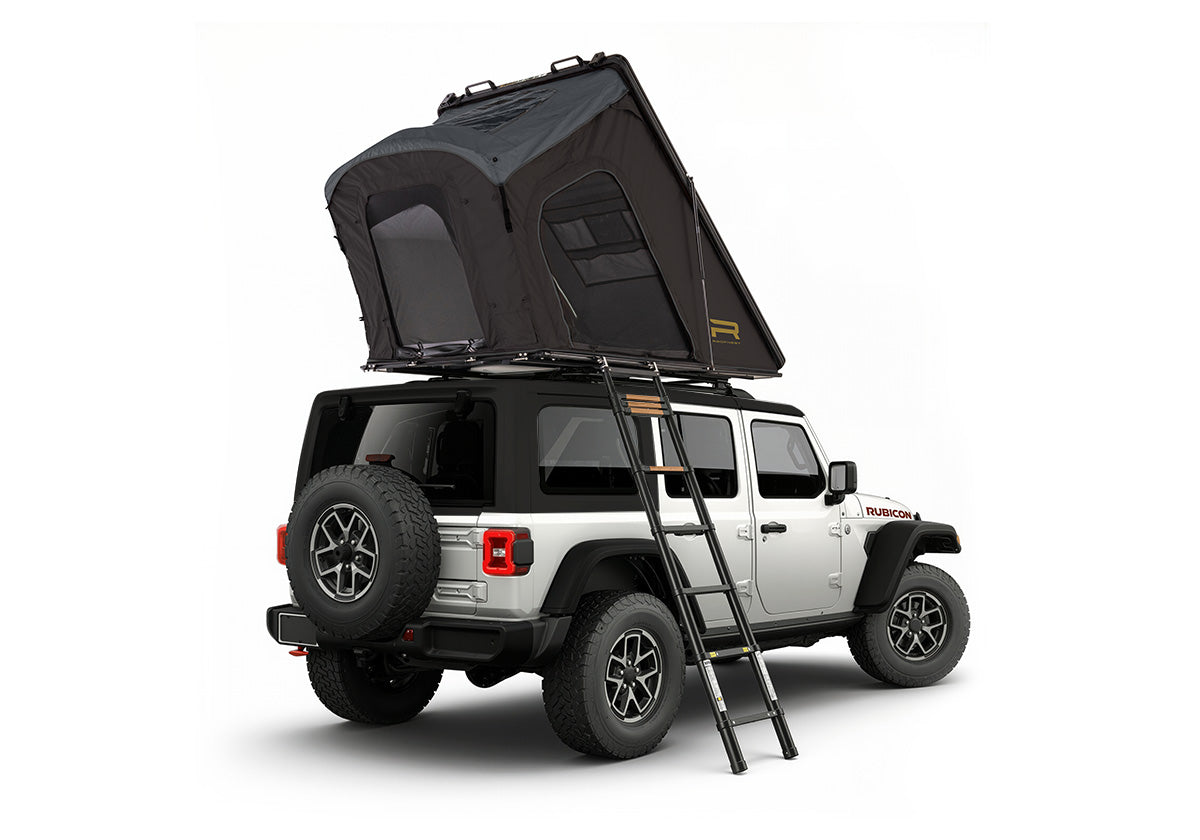
If you’re shopping for a hardshell rooftop tent for a Jeep Wrangler in 2026, you’re almost certainly picking between two names: Roofnest Falcon or iKamper Skycamp. They’re the two most-recommended hardshell RTTs in the overland community, they occupy overlapping price tiers, and both fit a Jeep Wrangler.
But they’re not the same tent, and buying the wrong one for your use case is a $3,000+ mistake.
The Roofnest Falcon is a pop-up wedge-style hardshell — it opens with a single motion, sleeps 2 comfortably, and has the sleekest closed profile in its class. The iKamper Skycamp is a fold-out hardshell — it opens in an X-Cover pattern, doubling the sleeping footprint and comfortably sleeping 3-4 people, but sits taller and heavier when closed.
This post covers what each does best, where each falls short, and — most importantly — which one to buy for how you actually camp. I’ll skip the spec-sheet comparison you can find on the manufacturers’ sites and focus on the buying decision.
If you’re still deciding whether you even want hardshell vs softshell, our Best Rooftop Tents for Jeep Wrangler pillar covers 17 tents across all categories. This post is the narrow Falcon-vs-Skycamp head-to-head.
TL;DR — The 60-Second Verdict
Buy Roofnest Falcon if:
- You’re 1-2 people (solo or couple)
- You want the fastest setup time possible (~30 seconds, gas-strut assisted)
- You need the lowest closed profile (garage clearance, highway aerodynamics)
- You’re weight-conscious — Falcon is ~40-50 lbs lighter than Skycamp
- You value the cleanest wedge silhouette on a Jeep
Buy iKamper Skycamp 2X if:
- You’re 3-4 people (family, group)
- You want maximum sleeping area for the money
- Standing/dressing headroom matters to you
- You’re okay with a taller closed profile and more setup time
- You already trust the iKamper ecosystem (X-Cover, annex options)
One-line answer for a Wrangler owner: Falcon for couples. Skycamp for families. If you’re between the two and camping mostly with a partner, the Falcon’s better closed profile, faster setup, and lighter weight will make it feel like the right buy every single trip. If you have kids or camp with friends, the Skycamp’s extra footprint is non-negotiable.
The Two Tents in One Paragraph Each
Roofnest Falcon is a pop-up wedge hardshell. When closed, it looks like a low-profile rack-top box (~10″ tall). When open, gas struts lift the shell to create a triangular sleeping space with the peak at the front and the entrance at the rear. Setup takes ~30 seconds; teardown is comparable. The sleeping area comfortably fits 2 adults on a 50″ W x 84″ L mattress. Weight is ~135 lbs. The Falcon’s design philosophy is “less is more” — minimal closed profile, minimal setup, maximum aerodynamics.
iKamper Skycamp 2X is a fold-out hardshell. When closed, it’s ~13″ tall (taller than Falcon). To open, you unlatch the shell and physically fold it out — the roof pivots to become an extended overhang while a secondary section unfolds to double the floor space. Setup takes ~60 seconds. The sleeping area is 82″ W x 82″ L (roughly king-bed footprint) and comfortably fits 3-4 people. Weight is ~180 lbs. The Skycamp’s design philosophy is “maximum livable space” — larger interior, more headroom, integrated accessories ecosystem.
Direct Feature Comparison
| Feature | Roofnest Falcon | iKamper Skycamp 2X |
|---|---|---|
| Style | Pop-up wedge hardshell | Fold-out X-Cover hardshell |
| Base price | ~$3,200 | ~$3,899 |
| Sleeping capacity | 2 adults | 3-4 people |
| Sleeping area (W×L) | 50″ × 84″ | 82″ × 82″ |
| Closed height | ~10″ | ~13″ |
| Weight | ~135 lbs | ~180 lbs |
| Setup time | ~30 seconds | ~60 seconds |
| Teardown time | ~30 seconds | ~60-90 seconds |
| Shell material | Aluminum-composite | Fiberglass-reinforced composite |
| Stock mattress | 3″ foam | 3″ foam (upgradeable) |
| Included ladder | Yes | Yes |
| Annex / accessories | Available (Falcon Pro annex) | Broad ecosystem (annex, awnings, mattresses, insulation kits) |
| Warranty | 5-year limited | 2-year limited |
| Owner community | Growing, US-focused | Larger, global |
Where Roofnest Falcon Wins
Closed Profile Is Genuinely Sleeker
At ~10 inches tall closed, the Falcon has one of the lowest hardshell profiles on the market. This matters more than most buyers think:
- Garage clearance: Many suburban garages have 7-8″ door openings. A Jeep with a low-profile Falcon fits in garages that reject taller RTTs.
- Highway aerodynamics: Less frontal area = less drag = better fuel economy. Users report 1-2 MPG better with a Falcon vs a Skycamp on long highway drives.
- Aesthetics: The Falcon’s wedge shape complements a Jeep’s silhouette. The Skycamp’s boxier profile looks bigger.
For daily-driver Wranglers that occasionally camp, closed profile is a real quality-of-life factor.
Setup Time Is Half of Skycamp
Gas-strut assisted pop-up = ~30 seconds from closed to sleeping. Skycamp requires unlatching, physically folding the shell over, and adjusting stays — closer to 60-90 seconds real-world.
Not a huge deal on a two-night trip, but it adds up when you’re setting up at three campsites over a week. And the Falcon can be closed and moving in under a minute at 5 AM if you need to bug out.
Lighter Weight = Better on Stock Suspension
135 lbs vs 180 lbs = 45 lbs difference. Add a roof rack (typically 40-60 lbs), and you’re at 175-195 lbs on the roof of a Wrangler with a Falcon versus 220-240 lbs with a Skycamp.
For stock JK/JL suspensions, staying under 200 lbs on the roof helps preserve handling and reduces the argument for a lift kit. Skycamp owners often end up upgrading suspension; Falcon owners more rarely.
5-Year Warranty Is Best in Class
Roofnest offers a 5-year limited warranty on the Falcon. iKamper offers 2 years on the Skycamp. For a $3,000+ purchase, the extra 3 years of coverage is a meaningful long-term value.
Where iKamper Skycamp 2X Wins
Sleep Space Isn’t Even Close
The Skycamp 2X sleeps 3-4 comfortably; the Falcon sleeps 2. This is the single biggest reason someone picks Skycamp — if you have a family or camp with friends, the Falcon simply won’t fit everyone.
Even for couples, some prefer the Skycamp’s larger footprint for the additional roll-around space and headroom.
Headroom Is Meaningfully Better
Falcon’s wedge shape means you can only sit upright at the rear (peak) of the tent. Skycamp’s fold-out design gives you ~4 feet of standing headroom at the center — enough to change clothes standing up, sit up cross-legged anywhere in the tent, and generally move around comfortably.
For anyone over 6′ tall or who spends more than 2-3 nights in a tent per trip, headroom is a comfort multiplier.
The Ecosystem Is Wider
iKamper has built a broad accessories ecosystem: annex rooms, insulation kits, cross-bar mounts, awning integrations, mattress upgrades (see our rooftop tent mattress guide), even bike-mount attachments. If you’ll be adding to your setup over the years, the Skycamp gives you more upgrade paths.
Roofnest also has accessories, but the range is narrower.
Family / Group Camping Value
If you’re camping with kids or a partner + friend, one Skycamp is a much better solution than two Falcons (or a Falcon + ground tent). The Skycamp basically replaces a family-size ground tent, which is where a lot of buyers save real money by consolidating gear.
Where They’re Roughly Tied
- Build quality: Both are premium-tier RTTs with well-regarded fit and finish. Neither is meaningfully “better built” than the other.
- Stock mattress quality: Both ship with 3″ foam mattresses that most owners eventually upgrade — see our mattress guide for aftermarket picks.
- Weather resistance: Both are legitimately 4-season capable with the manufacturer’s optional insulation kits. Both handle rain and snow well.
- Included ladder: Both include a telescoping aluminum ladder.
- Roof rack compatibility: Both fit standard crossbars (60″+ spread). Both mount to Wrangler rack systems without special hardware.
- Retention of value: Both hold resale value well — expect 60-70% of original price after 3 years.
The Pricing Fine Print
Advertised prices don’t tell the whole story on either tent.
Roofnest Falcon:
- Base Falcon: ~$3,195
- Falcon Pro (upgraded mattress, better shell): ~$3,795
- Add-ons: annex (~$500), insulation kit (~$300), mattress upgrade (~$249-449)
iKamper Skycamp 2X:
- Base Skycamp 2X: ~$3,899
- Skycamp DLX (upgraded shell): ~$4,299
- Add-ons: annex (~$400), insulation kit (~$400), mattress upgrade (~$399)
The real math: Base-to-base, the Skycamp is ~$700 more expensive than the Falcon. Add matched insulation kits and annex accessories, and you’re at ~$4,700 (Falcon complete) vs ~$5,100 (Skycamp complete). For that ~$400 delta, you get significantly more sleeping space, taller interior, and the broader accessory ecosystem.
Free trials / return policies: Neither offers a “sleep on it” trial. Both offer 30-day return windows on unopened product. Once you’ve installed and camped in it, you’re committed.
Which Should You Buy? (Real Recommendations by User Type)
Solo overlander → Roofnest Falcon
Falcon’s smaller footprint isn’t a limitation for solo camping — it’s an advantage (less canvas to heat, less weight, faster setup). The Falcon Pro upgrade is the right call if you’ll be in cold weather.
Couple, occasional camping (5-10 nights/year) → Roofnest Falcon
You don’t need the Skycamp’s extra space, and the Falcon’s lower closed profile means it doesn’t dominate your Jeep’s daily-driver silhouette. Save the $700 and put it toward a good mattress upgrade + a proper awning.
Couple, frequent camping (15+ nights/year) → Either, honestly
Both work. Falcon wins on daily-driver profile, setup time, and warranty. Skycamp wins on interior comfort and headroom. Toss a coin — you can’t buy the wrong one at this frequency.
Family with 1-2 kids → iKamper Skycamp 2X
The Skycamp is genuinely a family tent. Two adults + two small kids fits comfortably. Two adults + one older kid is spacious. The Falcon simply doesn’t have the footprint for a family.
Group camping with friends → iKamper Skycamp 2X
Same logic. Three adults can share the Skycamp; the Falcon caps at two.
Cold-weather / winter overlanding → Slight edge to Falcon
Smaller footprint = easier to heat with a portable heater. Both are 4-season capable with insulation kits, but the Falcon’s lower volume warms up faster.
Weight-conscious build (stock suspension) → Roofnest Falcon
135 lbs vs 180 lbs on the roof matters for stock JK/JL handling. If you’re not planning a suspension upgrade, the Falcon preserves more of the factory drive feel.
FAQ
Which tent is easier to set up?
Roofnest Falcon by a meaningful margin. ~30 seconds vs ~60 seconds real-world for the Skycamp. Both are easy compared to softshell tents (which take 5+ minutes).
Can I fit an iKamper Skycamp on a 2-door Jeep Wrangler?
Yes, but the Skycamp’s fold-out design means the extended portion hangs off the rear of the vehicle. On a 2-door JK/JL, this is workable but visually significant. Most 2-door owners prefer the Falcon.
Which one is better in wind?
Falcon. The lower profile and wedge shape catch less wind at highway speeds and while parked. Skycamp’s taller closed profile means more sway in high winds.
Do both tents fit on standard roof racks?
Yes. Both mount to standard 60″+ crossbar spreads. If you’re running a Jeep-specific rack like Front Runner Slimline II, Rhino-Rack Pioneer, or Yakima LoadWarrior, both will fit. See our roof rack guide for platform picks.
Is the extra space of the Skycamp worth $700 more?
If you need it, yes. If you don’t, no. This is entirely a “solo/couple vs family/group” question. Buyers who “future-proof” by getting the Skycamp for a family they don’t yet have almost always regret carrying the extra weight and profile for years.
Which one holds resale value better?
Both hold value well — 60-70% after 3 years on the used market. Slight edge to iKamper because the global market for used iKamper is larger, but not by a lot.
What’s the actual difference in fuel economy between the two?
1-2 MPG typical delta on highway driving. Falcon’s lower profile catches less air. Real-world, most owners report ~10% better fuel economy with a Falcon vs a Skycamp on 500+ mile highway trips.
Can I switch tents later if I choose wrong?
Yes, both hold strong resale value, but transaction friction (selling, buying, shipping) costs 20-30% of the tent’s value. Better to buy the right one first.
Final Recommendation
If you’re a solo overlander or a couple: Buy the Roofnest Falcon. Lower profile, lighter weight, faster setup, longer warranty. You’ll notice these advantages on every trip.
If you have kids or camp with more than 2 people: Buy the iKamper Skycamp 2X. The extra sleep space and headroom are non-negotiable at that group size. The $700 premium is real value if you’ll use the space.
If you’re on the fence: Default to the Falcon. You can always sleep bigger in a smaller tent, but you can’t sleep two extra people in a tent that doesn’t have the footprint. And most Wrangler owners are solo or couples.
Neither is a bad buy. Both are genuinely premium products from established brands with real support. The question is fit-for-purpose, not fit-for-brand.
Related Reading
- Best Rooftop Tents for Jeep Wrangler (2026) — The full 17-tent comparison, if you want to see all your options
- Best Rooftop Tent Mattress Upgrades — Aftermarket mattresses to upgrade the stock one in either tent
- Best Roof Rack for Jeep JK — Where either tent mounts
- Best Awning for Jeep Wrangler — The shade side of your basecamp
If you’ve chosen Roofnest: Compare Roofnest Falcon vs Roofnest Condor to pick the specific Roofnest model that fits your group size.
If you’ve chosen iKamper: Compare iKamper Skycamp Mini vs DLX to pick the specific Skycamp model that fits your group size.