
✅ Quick Answer
Skip the reading and check current pricing:
If you’re shopping for a premium awning for your Jeep Wrangler in 2026, you’re almost certainly deciding between two brands: ARB or Rhino-Rack. They’re the two most-recommended awning makers in the overland community. They’re priced within $200 of each other. They’re both from Australia, both battle-tested, and both trusted by Land Cruiser and Wrangler owners for decades.
But they solve shade differently, and buying the wrong one for your use case is a ~$1,000 mistake.
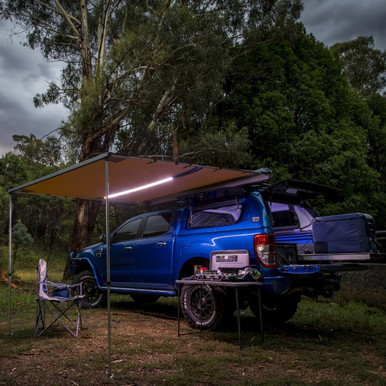
The ARB Touring 2500 is a straight-side awning — it deploys along one side of the vehicle to give you a clean rectangular shade area. The Rhino-Rack Batwing is a 270-degree wraparound awning — it opens like a bat wing to shade the side, rear, and part of the front of the vehicle simultaneously.
This post covers what each does best, where each falls short, and — most importantly — which one to buy for how you actually camp. If you’re still deciding between awning formats generally (270° vs 180° vs straight), our 270 vs 180 Awning comparison covers that first. This post is the narrow ARB-vs-Batwing head-to-head across brands.
TL;DR — The 60-Second Verdict
Buy the ARB Touring 2500 if:
- You want the highest-quality straight-side awning available
- You value simplicity — single support pole, single-side deployment
- You already run ARB gear (bumpers, drawers, etc.) and want ecosystem consistency
- You want the option to add ARB’s room/wall accessories to enclose your basecamp
- You need serious wind resistance — ARB’s side stays are the best in class
Buy the Rhino-Rack Batwing if:
- You want maximum shade coverage from a single awning (270° wraparound)
- You camp in variable-wind conditions where sun angle changes throughout the day
- You want the “drive up, deploy, done” single-motion setup
- You already run a Rhino-Rack Pioneer or Batwing-compatible platform
- You want the best-known name in wraparound awnings
One-line answer for a Wrangler owner: Batwing for coverage. ARB for simplicity. If you camp in one spot for multiple days and want shade everywhere your kit lives, the Batwing wins. If you’re a set-up-and-tear-down overlander who wants a clean, reliable, straight-side awning, ARB wins.
Ready to buy? Check current pricing:
The Two Awnings in One Paragraph Each
ARB Touring 2500 is a straight-side awning that deploys along the driver or passenger side of the Wrangler. Rolled up, it’s a compact ~11″ diameter tube mounted to your roof rack. Deployed, it’s a 2.5m × 2.5m (~8.2′ × 8.2′) rectangular shade area supported by a single retractable pole at the outer corner. Setup takes ~2 minutes. ARB’s reputation is built on its side stays and canvas quality — this is the awning most overland outfitters recommend for serious wind. Weight is ~35 lbs. Base price ~$450, with premium versions (integrated LED, upgraded fabric) up to ~$750.
Rhino-Rack Batwing is a 270-degree wraparound awning that mounts to one side of the vehicle and swings out to cover the side, rear, and part of the opposite side. Rolled up, it’s a ~12″ diameter tube. Deployed, it’s ~2.4m × 2.4m of coverage (measured on each of the three sides). Setup takes ~3 minutes on the first attempt; ~90 seconds after you’ve done it a few times. Weight is ~48 lbs. Base price ~$650, with the Batwing Compact and LED-integrated versions ranging up to ~$900.
Direct Feature Comparison
| Feature | ARB Touring 2500 | Rhino-Rack Batwing | Buy |
|---|---|---|---|
| Style | Straight-side awning (one side) | 270° wraparound | Rhino-Rack Batwing ARB Touring 2500 |
| Base price | ~$450 | ~$650 | Rhino-Rack Batwing ARB Touring 2500 |
| Shade coverage (deployed) | ~67 sq ft (single side) | ~135 sq ft (3-side wraparound) | Rhino-Rack Batwing ARB Touring 2500 |
| Weight | ~35 lbs | ~48 lbs | Rhino-Rack Batwing ARB Touring 2500 |
| Rolled-up diameter | ~11″ | ~12″ | Rhino-Rack Batwing ARB Touring 2500 |
| Setup time | ~2 minutes | ~90 sec (after practice) | Rhino-Rack Batwing ARB Touring 2500 |
| Support poles | 1 corner pole (retractable) | 2 corner poles + stays | Rhino-Rack Batwing ARB Touring 2500 |
| Wind resistance | Best-in-class side stays | Very good with proper staking | Rhino-Rack Batwing ARB Touring 2500 |
| Ecosystem/accessories | ARB room/wall enclosures | Full Batwing tent room, LED, Rhino-Rack platforms | Rhino-Rack Batwing ARB Touring 2500 |
| Warranty | 3-year fabric, lifetime frame | 3-year fabric | Rhino-Rack Batwing ARB Touring 2500 |
| Made in | Australia | Australia | Rhino-Rack Batwing ARB Touring 2500 |
Where the ARB Touring 2500 Wins
Wind Resistance Is Best in Class
ARB’s side stays are what overland outfitters recommend when you’ll be in wind. The stays are heavier-gauge aluminum than the Batwing’s, the mounting brackets are stouter, and the geometry is designed for the awning to flex rather than fold in gusts.
For desert overlanders (Moab, Baja, Arizona) where afternoon wind is guaranteed, the ARB is the safer buy. Batwing owners in high-wind terrain often report needing to pack the awning up early when weather turns.
Simplicity: One Pole, One Side, Done
Straight-side means one support pole and one deployment direction. No 270-degree geometry to manage, no wrap-around adjustment, no “which way does the wing go” confusion at 5 AM.
For solo overlanders or anyone who values operational simplicity, this matters. The Batwing rewards muscle memory; the ARB works on trip one.
Lighter Weight = Better on Stock Suspension
35 lbs vs 48 lbs = 13 lbs difference. Add to a fully loaded rack (rooftop tent + rack itself + gear), and the awning weight matters. For stock JK/JL suspensions, staying lean up top preserves handling.
Cheaper Entry Point
Base ARB Touring 2500 is ~$450 vs Batwing at ~$650 — a $200 delta at entry, which grows to ~$300 with premium features on each. If budget is tight and you don’t need 270° coverage, ARB gets you a premium-tier awning at a mid-tier price.
Room/Wall Enclosure Options
ARB sells modular room extensions that clip to the Touring 2500 — effectively turning it into an enclosed tent room. For extended-stay basecamps (a week in Moab, hunting season, ski touring), this converts your awning into a real shelter for cooking, changing, and storing gear out of weather. Batwing has similar options but ARB’s room system is more mature.
Where the Rhino-Rack Batwing Wins
Coverage Isn’t Even Close
~135 sq ft of shade (three sides wrapped around the vehicle) vs ~67 sq ft (single side). The Batwing gives you literally 2x the shade area from a single awning.
For basecamp use — where you’re cooking on one side, sleeping on another, and hanging out under the awning all day — the wraparound coverage is the entire buying case for Batwing. You get shade everywhere your kit is, not just along one side of the vehicle.
Sun Follows You (In a Good Way)
Because the Batwing wraps 270 degrees, you always have shade regardless of where the sun is in the sky. Morning shade on one side, midday on another, evening on the third — without moving the awning.
Straight-side ARB awnings work great when the sun is directly to one side, but shade shifts throughout the day. In summer campsites where you’re parked all day, the Batwing’s wraparound is a genuine quality-of-life difference.
Single-Motion Deployment (After Practice)
Rhino-Rack designed the Batwing to open with a single swing motion — you unlatch, swing the wing outward, and it’s deployed. After 2-3 uses, most owners can set it up in ~90 seconds without thinking. That’s faster than the ARB’s 2-minute setup once you’ve got the muscle memory.
Ecosystem: Batwing Compact + LED Kit + Tent Room
Rhino-Rack has built out the Batwing ecosystem: a smaller Batwing Compact for shorter wheelbases, an integrated LED kit that runs off your Wrangler’s 12V, and a full Batwing Tent Room that clips to the underside to create an enclosed 3-side basecamp shelter. If you plan to add to your awning setup over the years, the ecosystem depth matters.
Best-Known Brand in Wraparound Awnings
Rhino-Rack essentially invented the wraparound category. The Batwing is the awning nearly every overlander mentions when the topic of 270° coverage comes up. Resale value stays high because the brand recognition is universal.
Where They’re Roughly Tied
- Build quality: Both are premium-tier from established Australian brands. Neither is meaningfully “better built” than the other.
- Fabric quality: Both use waterproof, UV-resistant canvas rated for years of exposure. Both offer 3-year fabric warranties.
- Roof rack compatibility: Both mount to standard crossbar spreads. Both work with Front Runner Slimline II, Rhino-Rack Pioneer, and Yakima LoadWarrior. Neither requires proprietary rack hardware.
- Weather resistance: Both handle rain and moderate wind well. Both need to be closed in severe weather.
- Retention of value: Both hold resale value well — expect 65-75% of original price after 3 years for either.
- Support / warranty response: Both companies have solid customer service reputations with US-based dealer networks.
The Pricing Fine Print
Advertised prices don’t tell the whole story on either awning.
ARB Touring 2500:
- Base Touring 2500 (2.5m): ~$450
- Touring 2500 with LED kit: ~$550
- Touring 2500 with room extension: ~$450 awning + ~$400-600 room kit
- Deluxe fabric upgrade (heavier canvas): +$150
Rhino-Rack Batwing:
- Base Batwing (aluminum): ~$650
- Batwing Compact (shorter wheelbase): ~$550
- Batwing LED integrated kit: +$150
- Batwing Tent Room (full enclosure): +$400
The real math: Base-to-base, the Batwing is ~$200 more. Add matched LED kits, and you’re at ~$550 (ARB) vs ~$800 (Batwing). For that $250 delta, you get 2x the shade coverage. Whether that’s worth it depends entirely on how much time you spend camped in one spot.
Return policies: Both offer standard 30-day return on unopened product. Neither offers a “deploy and test” return once mounted.
Which Should You Buy? (Real Recommendations by User Type)
Solo overlander, moves camp daily → ARB Touring 2500
If you’re setting up and tearing down every night, the ARB’s simpler deployment saves time and reduces the “where does this piece go” friction. Straight-side is enough coverage for solo cooking + hanging out.
Basecamp overlander (multi-day at one site) → Rhino-Rack Batwing
If you’re parking for 2+ days and living under the awning all day, wraparound coverage is the entire game. You’ll have shade wherever the sun is, without moving the awning or repositioning gear.
Windy/desert overlander (Moab, Baja, Southwest) → ARB Touring 2500
ARB’s side stays are the wind-tested choice. If afternoon wind is a factor in your typical trip, ARB is the safer buy. Batwing works in wind with proper staking but ARB is more forgiving.
Family/group camping → Rhino-Rack Batwing
More people = more shade needed. 135 sq ft of wraparound coverage means everyone fits under the awning, kids can play in shade, and the cooking area doesn’t compete with the hangout area.
Weight-conscious build (stock suspension) → Slight edge to ARB
35 lbs vs 48 lbs matters if you’re already loaded up with a rooftop tent, roof rack, and other gear on the roof. For stock JK/JL Wranglers running full overland kits, ARB preserves more of the factory drive feel.
Already own Rhino-Rack Pioneer platform → Consider Batwing first
The Batwing has direct-mount kits for Rhino-Rack Pioneer platforms that skip the universal-mount step. If you’re already in the Rhino-Rack ecosystem, the Batwing is the cleaner install.
Already own ARB bumpers / drawers → Consider ARB first
Same logic reversed. If you’re building an ARB-centric Wrangler, staying in-ecosystem gives you consistent branding, warranty channels, and dealer support.
FAQ
Which awning is easier to set up?
ARB Touring 2500, on the first attempt. ~2 minutes with clear directional intuition (one pole, one direction). The Batwing takes 3-4 minutes on your first try; ~90 seconds after 2-3 uses. Both are easy compared to older telescoping awnings.
Can I run both awnings on the same Jeep?
Physically yes — some overlanders mount one on each side of the vehicle for maximum coverage. Not practical for most, but not impossible. The more common setup is picking one and adding an ARB room extension or Batwing tent room to expand coverage vertically.
Which one is better in wind?
ARB, meaningfully. ARB’s side stays and pole geometry are the wind-tested benchmark. Batwing works in wind with proper staking but ARB is more forgiving. In severe weather, close either one.
Do both awnings fit on any roof rack?
Yes. Both mount to standard crossbar spreads and are compatible with Front Runner Slimline II, Rhino-Rack Pioneer, Yakima LoadWarrior, and most Jeep-specific racks. See our roof rack guide for platform picks.
Is the Batwing’s extra coverage worth $200 more?
For basecamp use (multi-day at one site), yes — wraparound shade is a real quality-of-life upgrade. For daily-move overlanders who use the awning primarily for cooking, no — the ARB’s straight-side is enough.
Which one holds resale value better?
Both hold value well — 65-75% after 3 years on the used market. Slight edge to Batwing because the brand is more universally recognized in the wraparound category.
Can I install a room / enclosure on the ARB or Batwing?
Yes to both. ARB sells the ARB Awning Room (~$400-600) that clips to the Touring 2500. Rhino-Rack sells the Batwing Tent Room (~$400) that creates a 3-side enclosure. Both convert your awning into an enclosed basecamp shelter.
What if I want 180° coverage instead of 270°?
Neither of these is a 180° awning. If you want 180° wraparound, look at Yakima Slimshady or Front Runner Wraparound. Our 270 vs 180 Awning comparison covers the format decision in detail.
Final Recommendation
If you basecamp at one site for multiple days: Buy the Rhino-Rack Batwing. 2x the shade coverage is the entire game for basecamp use. The $200 premium pays back on your first multi-day trip.
If you move camp daily or camp in windy terrain: Buy the ARB Touring 2500. Simpler deployment, lighter weight, and best-in-class wind resistance. You’ll appreciate the simplicity every setup.
If you’re on the fence: Default to the Batwing. Wraparound coverage is one of those features that’s hard to appreciate until you have it, then impossible to go back from. Most Wrangler owners eventually settle here.
Neither is a bad buy. Both are genuinely premium products from established brands with real support. The question is fit-for-use, not fit-for-brand.
Related Reading
- Best Awning for Jeep Wrangler (2026) — The full 14-brand comparison, if you want to see all your options
- 270 vs 180 Awning: Which Should You Buy — The awning format decision, one level up
- Best Roof Rack for Jeep JK — Where either awning mounts
- Best Rooftop Tents for Jeep Wrangler — The other half of your overland basecamp